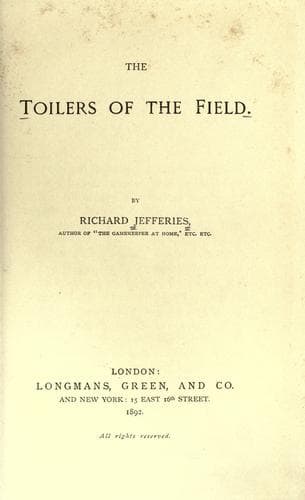
Agricultural laborers -- England; Country life -- England
of two or three generic names. The population appears to have been
stationary for scores upon scores of years. Say what you will, ridicule
it as you like, there is a charm clinging round that which time has
hallowed; and even the man of the hour, the successful speculator,
yields to this. It is his most eager desire to become a landed
proprietor, and if possible he buys a place where he can exercise
manorial rights.
Taking these things into consideration, it is only reasonable to admit
that agriculture is a profession in which a man may, above all others,
be excused if he manifests a certain amount of irritability at the
prospect of change. The slow round of uneventful years, the long
continuance of manual labour, the perpetual iteration of a few ideas, in
time produce in the mind of the most powerfully intellectual men a
species of unconscious creed; and this creed is religiously handed down
from generation to generation. Setting aside those who have gone into
agriculture as a science, and adapt everything to commercial
principles--and they are as yet not very numerous--the great mass of
farmers believe nearly the same now as they did two centuries ago.
Looking through a farmer's calendar published in the first few years of
this century, and containing a complete _resume_ of the system of
agriculture practised then, I was struck by the remarkable fact that in
all main features it was the same as that in use now. We have heard so
much of the rapid progress of agriculture, of the important changes
introduced, and of the complete revolution which has taken place, that
this statement may appear incredible. It is nevertheless the fact that
that book might be put with advantage into the hands of any young man
about to enter upon a farm. With the exception of those operations which
are now performed by steam, and making an allowance for the altered
conditions introduced by the abolition of the Corn Laws, the
instructions given there are useful down to this very day. Here is the
knowledge of the peculiarities and requirements of stock slowly
accumulated during ages of agriculture, and at last written down and
printed for easy reference. However much the aspect of politics may
change, or however much the means of locomotion and communication may be
facilitated by the introduction of steam, Nature still remains
unaltered. The cows and sheep retain their instincts and their internal
economy; their modes of feeding, times of rest, and seasons of increase,
never vary. The earth too has not changed. The corn is sown at the same
time; Nature goes on her way as before, heedless of the railway rattle.
So it is that the details of management in this book are as useful now
as then, more than two generations since. It is the same with the
unwritten faith of the men who labour and live among these things. Go
out among them, and collect from the majority their views and
sentiments, and in this age of progress they will be found to correspond
Public-domain text, read in full here on John Shaqi.
Reviews
Reviews
No reviews yet
Be the first to share your thoughts on this work.
Join the Discussion
Join the discussion
Sign in to leave a comment or review.
Sign InorCreate an account