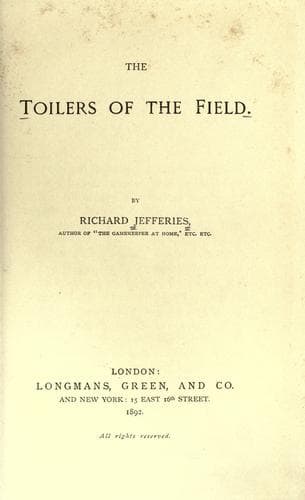
Agricultural laborers -- England; Country life -- England
In religion it is, or lately was, the same. It was not a matter with the
farmer of the Athanasian creed, or the doctrine of salvation by faith,
or any other theological dogma. To him the parish church was the centre
of the social system of the parish. It was the keystone of that parental
plan of government that he believed in. The very first doctrine preached
from the pulpit was that of obedience. "Honour thy father and mother"
was inculcated there every seventh day. His father went to church, he
went to church himself, and everybody else ought to go. It was as much a
social gathering as the dinner at the market ordinary, or the annual
audit dinner of their common landlord. The dissenter, who declined to
pay church-rates, was an unsocial person. He had left the circle. It was
not the theology that they cared about, it was the social nonconformity.
In a spiritual sense, too, the clergyman was the father of the parish,
the shepherd of the flock--it was a part of the great system. To go a
step farther, in political affairs the one leading idea still threaded
itself through all. The proper parliamentary representative--the natural
law-giver--was the landlord of the district. He was born amongst them,
walked about amongst them, had been in their houses many a time. He knew
their wants, their ideas, their views. His own interest was identical
with theirs. Therefore he was the man. The logic is indisputable. What
is more, they acted up to it. In agricultural districts it is not
uncommon even now to find men of diametrically opposite political views
to the candidate at an election voting for and supporting him, simply
and solely because he is the local man. It is natural and right that he
should represent them. That one word "right" is the key to the whole
ethical system of the agriculturists. They cherish and maintain their
belief in right, and in their "rights"--by which they understand much
the same thing--even when unaccompanied by any gain or advantage. In
brief outline, such is the creed of the agriculturists as a body. It is
neither written nor spoken, but it is a living faith which influences
every hour of their lives.
This faith must ever be borne in mind by those who wish to understand
the movements of the agricultural world. Without making a proper
allowance for it, the farmers will be easily misjudged.
Public-domain text, read in full here on John Shaqi.
Reviews
Reviews
No reviews yet
Be the first to share your thoughts on this work.
Join the Discussion
Join the discussion
Sign in to leave a comment or review.
Sign InorCreate an account