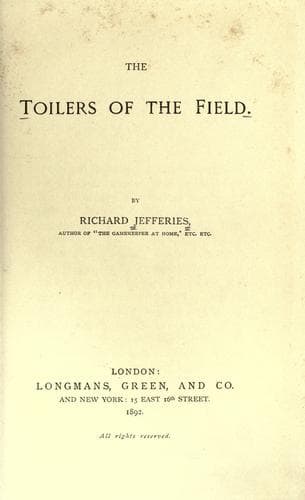
Agricultural laborers -- England; Country life -- England
The ordinary adult farm labourer commonly rises at from four to five
o'clock; if he is a milker, and has to walk some little distance to his
work, even as early as half-past three. Four was the general rule, but
of late years the hour has grown later. He milks till five or half-past,
carries the yokes to the dairy, and draws water for the dairymaid, or
perhaps chops up some wood for her fire to scald the milk. At six he
goes to breakfast, which consists of a hunch of bread and cheese as the
rule, with now and then a piece of bacon, and as a milker he receives
his quart of beer. At breakfast there is no hurry for half-an-hour or
so; but some time before seven he is on at the ordinary work of the day.
If a milker and very early riser, he is not usually put at the heavy
jobs, but allowances are made for the work he has already done. The
other men on the farm arrive at six. At eleven, or half-past, comes
luncheon, which lasts a full hour, often an hour and a quarter. About
three o'clock the task of milking again commences; the buckets are got
out with a good deal of rattling and noise, the yokes fitted to the
shoulders, and away he goes for an hour or hour and a half of milking.
That done, he has to clean up the court and help the dairymaid put the
heavier articles in place; then another quart of beer, and away home.
The time of leaving off work varies from half-past five to half-past
six. At ordinary seasons the other men leave at six, but in haymaking or
harvest time they are expected to remain till the job in hand that day
is finished, often till eight or half-past. This is compensated for by a
hearty supper and almost unlimited beer. The women employed in field
labour generally leave at four, and hasten home to prepare the evening
meal. The evening meal is the great event of the day. Like the
independent gentleman in this one thing, the labourer dines late in the
day. His midday meal, which is the farmer's dinner, is his luncheon. The
labourer's dinner is taken at half-past six to seven in the evening,
after he has got home, unlaced his heavy and cumbrous boots, combed his
hair, and washed himself. His table is always well supplied with
vegetables, potatoes, and particularly greens, of which he is peculiarly
fond. The staple dish is, of course, a piece of bacon, and large
quantities of bread are eaten. It is a common thing now, once or twice
in the week, for a labourer to have a small joint of mutton, not a
prime joint, of course, but still good and wholesome meat. Many of them
live in a style, so far as eating and drinking is concerned, quite equal
to the small farmers, and far superior to what these small farmers were
used to. Instead of beer, the agricultural labourer frequently drinks
tea with his dinner--weak tea in large quantities. After the more solid
parts comes a salad of onions or lettuce. These men eat quantities which
would half kill many townspeople. After dinner, if it is the season of
Public-domain text, read in full here on John Shaqi.
Reviews
Reviews
No reviews yet
Be the first to share your thoughts on this work.
Join the Discussion
Join the discussion
Sign in to leave a comment or review.
Sign InorCreate an account