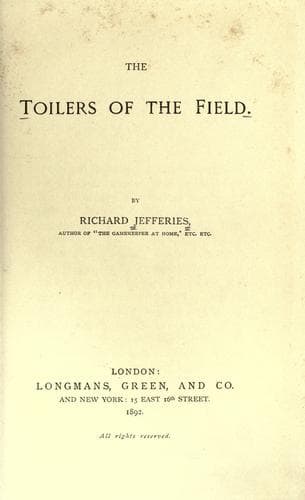
Agricultural laborers -- England; Country life -- England
skittles and such games, he has no amusement left except to drink, or
play at pitch and toss on the quiet, a far worse pastime than skittles.
Skittles, of course, are allowed provided the players play for love
only; but what public-house keeper cares to put up the necessary
arrangements on such terms? The labourer will have his quart in the
evening, and, despite of all "cry" to the contrary, I believe it to be
his right to have that quart; and it is better, if he must have it, that
his whole thoughts should not be concentrated on the liquor--that he
should earn it by skill and strength. There is an opprobrium about the
public-house, and let us grant that it is at least partially
deserved--but where else is the labourer to go? He cannot for ever work
all day and sit in his narrow cabin in the evening. He cannot always
read, and those of his class who do read do so imperfectly. A
reading-room has been tried, but as a rule it fails to attract the
_purely agricultural labourer_. The shoemaker, the tailor, the village
post-master, grocer, and such people may use it; also a few of the
better-educated of the young labourers, the rising generation; but not
the full-grown labourer with a wife and family and cottage. It does good
undoubtedly; in the future, as education extends, it will become a place
of resort. But at present it fails to reach the adult genuine
agricultural labourer. For a short period in the dead of the winter the
farmers and gentry get up penny readings in many places, but these are
confined to at most one evening a week. What, then, is the labourer to
do? Let any one put himself in his place, try to realise his feelings
and circumstances. At present, till education extends, he must go to the
public-house. Is he to be punished and deprived of his game of skill
because in large towns it bears evil fruit? Surely the law could be
somewhat modified, and playing permitted under some restrictions.
The early closing has been an unalloyed good in these rural districts.
The labourer is a steady drinker. He does not toss down glasses of stiff
brandy and whisky. His beer requires time to produce an effect. The last
hour does the mischief. Since the earlier closing the village streets
have been comparatively free from drunken men. In any case, the
agricultural labourer is the most lamb-like of drunkards. He interferes
with no one. He unhinges no gates, smashes no windows, does no injury.
He either staggers home or quietly lies on the grass till the liquor
passes off. He is not a quarrelsome man. He does not fight with
knuckle-dusters or kick with his heavy boots. His fights, when he does
fight, are very harmless affairs. No doubt his drunkenness is an
offence; but it is comparatively innocuous to the general public.
Public-domain text, read in full here on John Shaqi.
Reviews
Reviews
No reviews yet
Be the first to share your thoughts on this work.
Join the Discussion
Join the discussion
Sign in to leave a comment or review.
Sign InorCreate an account