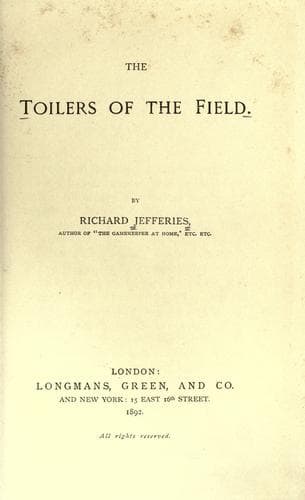
Agricultural laborers -- England; Country life -- England
There is nothing connected with the condition of the agricultural poor
that is better worth the attention of improvers than the style of
cookery pursued in these cottages. A more wretched cookery probably does
not exist on the face of the earth. The soddened cabbage is typical of
the whole thing. Since higher wages have come in it has become possible
for the labourer in many cases to provide himself with better food, such
as mutton--the cheap parts--more bacon, pork, and so on; but the women
do not know how to make the most of it. It is very difficult to lay down
a way in which this defect may be remedied; for there is nothing a man,
let him be never so poor, so deeply resents as an inspection of the
contents of his pot. He would sooner eat half-raw bacon than have the
teaching forced on him--how to make savoury meals of the simple
provisions within his reach; nor can he be blamed for this sturdy
independent feeling. Possibly the establishment of schools of cookery in
villages might do much good. They might be attached to the new schools
now building throughout the country. The labourer, from so long living
upon coarse, ill-cooked food, acquires an artificial taste. Some men eat
their bacon raw; others will drink large quantities of vinegar, and well
they may need it to correct by its acidity the effects of strong
unwholesome cabbage. The cottage cook has no idea of those nutritious
and pleasant soups which can be made to form so important a feature in
the economy of daily life.
The labourer is in a lower degree of the same class as the third-rate
working farmer of the past. He is the old small dairy farmer in a
coarser shape. With a little less education, ruder manners, with the
instincts of eating, drinking, and avarice more prominently displayed,
he presents in his actual condition at this day a striking analogy to
the agriculturist of a bygone time. In fact, those farmers of twenty or
thirty acres, living in cottage-like homesteads, were barely
distinguishable as far as _personnel_ went from the labourers among whom
they lived. This being the case, it is not surprising to find that the
labourer of this day presents in general characteristics a marked
affinity in ideas and sentiments to those entertained by the old
farmer. He has the same paternal creed in a more primeval form. He
considers his children as his absolute property. He rules them with a
rod of iron, or rather of ground-ash. In fact, the ground-ash stick is
his social religion. The agricultural labouring poor are very rough and
even brutal towards their children. Not that they are without affection
towards them, but they are used to thrash them into obedience instead of
leading them into it by the gentle means of moral persuasion.
Public-domain text, read in full here on John Shaqi.
Reviews
Reviews
No reviews yet
Be the first to share your thoughts on this work.
Join the Discussion
Join the discussion
Sign in to leave a comment or review.
Sign InorCreate an account