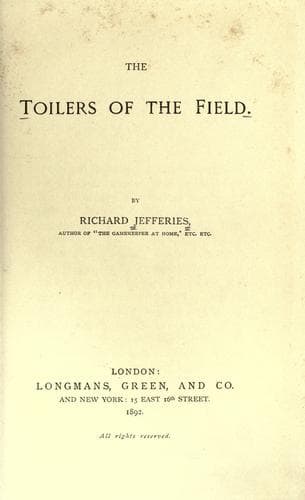
Agricultural laborers -- England; Country life -- England
From earliest dawn to latest night they swing
the sickles, staying with their husbands, and brothers, and friends,
till the moon silvers the yellow corn. The reason is because reaping is
piece-work, and not paid by the day, so that the longer and the harder
they work the more money is earned. In this a man's whole family can
assist. His wife, his grown-up sons and daughters cut the corn, the
younger ones can carry it and aid in various ways.
It is wonderful how the men stand the excessive and continuous labour;
it is still more wonderful how the women endure it, trying as it is to
the back. It is the hottest season of the year--the early autumn; the
sun burns and scorches, and the warm wind gives no relief; even the
evenings are close and sultry. The heated earth reflects the rays, and
the straw is dry and warm to the touch. The standing corn, nearly as
high as the reaper, keeps off the breeze, if there is any, from her
brow. Grasping the straw continuously cuts and wounds the hand, and even
gloves will hardly give perfect protection. The woman's bare neck is
turned to the colour of tan; her thin muscular arms bronze right up to
the shoulder. Short time is allowed for refreshment; right through the
hottest part of the day they labour. It is remarkable that none, or very
few, cases of sunstroke occur. Cases of vertigo and vomiting are
frequent, but pass off in a few hours. Large quantities of liquor are
taken to sustain the frame weakened by perspiration.
When night does arrive, even then the task is not over, for they have to
carry home on their heads the bundle of wheat gleaned by the smaller
children, and perhaps walk two miles to the cottage. This is indeed work
for a woman still suckling her child. It is not easy to calculate what a
woman earns at such seasons, because they rarely work on their own
account: either the father or the husband receives the wages in a lump
with his own; but it cannot be much less than that earned by a man; for
at these times they work with a will, and they do not at the haymaking.
While reaping the baby is nestled down on a heap of coats or shawls
under the shelter of the shocks of corn, which form a little hut for it,
and, as in the hayfield, is watched by one of the children. Often three
or four women will place their babies close together, and leave one
great girl in charge of the whole, which is an economy, releasing other
children for work; for the hayfield and the corn-harvest are the
labourer's gold-mine. There is not so much rough joking in the
corn-field; they do not work so close together, and the husband or
father is near at hand; neither is there time nor inclination in the
midst of such severe labour, to which haymaking is play.
Public-domain text, read in full here on John Shaqi.
Reviews
Reviews
No reviews yet
Be the first to share your thoughts on this work.
Join the Discussion
Join the discussion
Sign in to leave a comment or review.
Sign InorCreate an account