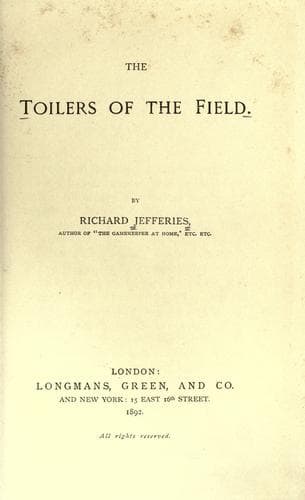
Agricultural laborers -- England; Country life -- England
On some farms large quantities of fruit are grown--such as gooseberries,
currants, plums, and damsons. Most have enough for their own use; some
sell a considerable amount. Outside the garden is the orchard. Some of
these orchards are very extensive, even in districts where cider is not
the ordinary beverage, and in a good apple year the sale of the apples
forms an important item in the peculiar emoluments of the farmer's wife.
There are, of course, many districts in which the soil is not adapted to
the apple, but as a rule the orchard is an adjunct of the garden. Some
of the real old English farmsteads possess the crowning delight of a
filbert walk, but these are rare now. In fact the introduction of
machinery and steam, and the general revolution which has been going on
in agriculture, has gone far to sweep away these more pleasant and
home-like features of the farm. It becomes daily more and more like a
mere official residence, so to speak. The peculiar home-like aspect of a
farmhouse is gradually disappearing.
The daily life of the middle-class dairy farmer begins at five in the
morning. Rising about that hour, his first duty is to see that the men
have all appeared, and that they are engaged in milking the cows. He
breakfasts at six, or half-past, and the whole family have finished
breakfast before seven. By this time the day-labourers have come (the
milkers are usually hired by the year), and the master has to go out and
put them on to their jobs. Meantime the dairy is a scene of work and
bustle; cheesemaking being in full swing. This is at least
superintended, if not partly performed, by the mistress of the house. At
larger farms it is the bailiff who rises early and sees that the
labourers are properly employed; and the cheesemaking is entrusted to a
dairymaid hired at high wages, who often combines with that duty the
office of general housekeeper. It was once the practice to rise even
earlier than five, but there are not many farmers who do so now. On the
arable farm, which is generally much larger, the master has almost
always got a bailiff, or head-carter, whom he can trust to see the men
set to work. The master is therefore not obliged to come down so soon,
except at important seasons. But the ordinary dairy-farm is not large
enough to support a bailiff, and the master has to rise himself. The
fresh morning air and the exercise give the farmer a tremendous appetite
for breakfast. The usual staple food consists of thick rashers of bacon
only just "done," so as to retain most of the fat, the surplus of which
is carefully caught on slices of bread. The town rasher is crisp,
curled, and brown, without a symptom of fat or grease. The farmer's
early rasher is to a town eye but half-done, bubbling with grease, and
laid on thick slices of bread, also saturated with the gravy. Sometimes
cold bacon is preferred, but it is almost always very fat. With this he
drinks a pint or so of fairly strong beer, and afterwards has a hunch of
Public-domain text, read in full here on John Shaqi.
Reviews
Reviews
No reviews yet
Be the first to share your thoughts on this work.
Join the Discussion
Join the discussion
Sign in to leave a comment or review.
Sign InorCreate an account