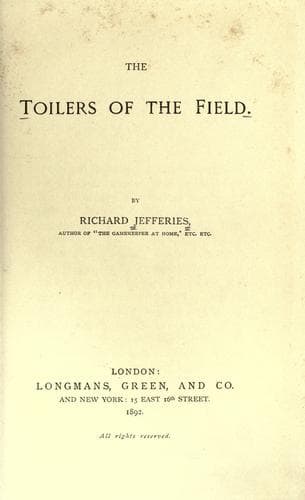
Agricultural laborers -- England; Country life -- England
"Ay, that I did," continued Jim, not seeing the drift of the remark. He
not only built it, but he brought up nineteen children in it, and
fourteen of them lived to grow up, all the offspring of one wife. And a
time she had of it, too. None of them ever fell in that pond, though he
often wished they would; and they were all pretty healthy, which was a
bad thing, because it made them hungry, and if they had been ill the
parish would have kept them. All that he had done on 12s. a week, and he
minded the time when it was only 9s., ay, and even when it was 6s., and
'twas better then than it was now with 15s. That was before the Unions
came about, in the time of the old workhouses in every parish. Then the
farmers used to find everybody a job. Every morning they had to go round
from one farmer to the other, and if there was no work then they went to
the workhouse, or sometimes to the vestry-room in the church, where
every man had a loaf of bread for every head there was in his family, so
that the more children he had the more loaves of bread, which was a
capital thing when the children were small. He had known a man in those
times sent seven miles with a wheelbarrow to fetch a barrow load of coal
from the canal wharf, and then have to wheel it back seven miles, and
get one shilling for his day's work. Still they were better times than
these, because the farmers for their own sake were forced to find the
fellows something to do; but now they did not care, and it was a hard
thing to find work, especially when a man grew old, and stiff about the
joints. Now the Boards of Guardians would not give any relief unless the
applicants were ill, or not able-bodied, and even then they were often
required to break stones, and he was very much inclined to throw his
spade in that old pond and go to the Union with the "missis" and all the
lot for good. He had the rheumatism bad enough. It would serve them
right. He had worked "nigh handy" sixty years; and all he had got by it
he could put in his eye. They ought to keep him now. It was not half so
good as the old times for all the talk; then the children could bring
home a bit of wood out of the hedges to boil the pot with, but now they
must not touch a stick, or there was the law on them in a minute. And
then coal at the price it was. Why didn't his sons keep him? Where were
they? One was a soldier, and another had gone to America, and the third
was married and had a hard job to keep himself, and the fourth was gone
nobody knew where. As for the wenches, they were no good in that way. So
he and his "missis" muddled on at home with three of the youngest. And
they could not let them alone even in that. He did go into the Union
workhouse for a bit, a while ago, when the rheumatism was extraordinary
bad, but some of the guardians smelt out that he had a cottage of his
own, and it was against the law to relieve anybody that had property; so
he must pay back the relief as a loan or sell the cottage. He was
Public-domain text, read in full here on John Shaqi.
Reviews
Reviews
No reviews yet
Be the first to share your thoughts on this work.
Elsewhere in the archive
Join the Discussion
Join the discussion
Sign in to leave a comment or review.
Sign InorCreate an account