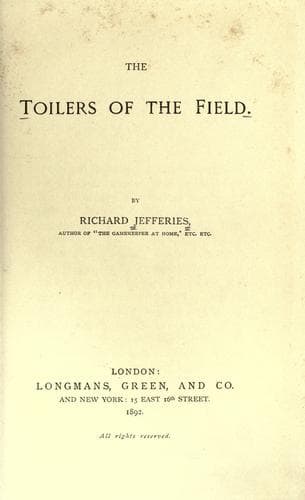
Agricultural laborers -- England; Country life -- England
offered L25 for the place and garden, and he meant to have taken it, but
when they came to look into the writings it was not clear that he could
sell it. It was quit-rent land, and although the landlord had not taken
the rent for twenty years, yet he had entered it in his book as paid
(out of good nature), and the lawyers said it could not be done. But as
they would not let him sell it, he would not turn out, not he. There he
would stop--just to spite them. He knew that nook of his was wanted for
cattle stalls on the new principle, and very handy it would be with all
that water close at hand, but he had worked for sixty years, and had had
nineteen children there, and he would not turn out. Not he. The parson's
"missis" and the squire's "missis" came the other day about that
youngest boy of his. They wanted to get him into some school up in
London somewhere, but he remembered how the squire had served him just
for picking up a dead rabbit that laid in his path one hard snow time.
Six weeks in gaol because he could not pay the fine. And the parson
turned him out of his allotment because he saw him stagger a little in
the road one night with the rheumatism. It was a lie that he was drunk.
And suppose he was? The parson had his wine, he reckoned. They should
not have his boy. He rather hoped he would grow up a bad one, and bother
them well. He minded when that sharp old Miss ---- was always coming
round with tracts and blankets, like taking some straw to a lot of pigs,
and lecturing his "missis" about economy. What a fuss she made, and
scolded his wife as if she was a thief for having that fifteenth boy!
His "missis" turned on her at last, and said, "Lor, miss, that's all the
pleasure me an' my old man got." As for this talk about the labourers'
Unions, it was all very well for the young men; but it made it worse
still for the old ones. The farmers, if they had to give such a price,
would have young men in full strength: there was no chance at all for an
old fellow of sixty-four with rheumatism. Some of them, too, were
terribly offended--some of the old sort--and turned off the few
pensioners they had kept on at odd jobs for years. However, he supposed
he must get back to that ditch again.
This long oration was delivered not without a certain degree of power
and effect, showing that the man, whatever his faults, might with
training have become rather a clever fellow. The very way in which he
contradicted himself, and announced his intention of never doing that
which a moment before he was determined on, was not without an amount of
oratorical art, since the turn in his view of the subject was led up to
by a variety of reasons which were supposed to convince himself and his
hearer at the same time. His remarks were all the more effective because
there was an evident substratum of stern truth beneath them. But they
failed to make much impression on Smith, who saw his companion depart
without a word.
Public-domain text, read in full here on John Shaqi.
Reviews
Reviews
No reviews yet
Be the first to share your thoughts on this work.
Elsewhere in the archive
Join the Discussion
Join the discussion
Sign in to leave a comment or review.
Sign InorCreate an account