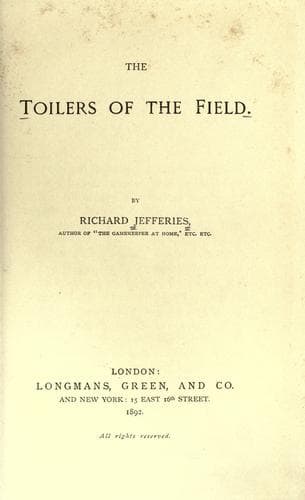
Agricultural laborers -- England; Country life -- England
In time he establishes a reputation as a
practical man, and being in receipt of good wages, with very little
expenditure, saves some money. He has now little difficulty in obtaining
the promise of a farm, and with this can readily take up money. With
average care he is a made man. Others rise from petty trading, petty
dealing in pigs and calves, till they save sufficient to rent a small
farm, and make that the basis of larger dealing operations. I question
very much whether a clerk in a firm would not find it much more
difficult, as requiring larger capital, to raise himself to a level with
his employer than an agricultural labourer does to the level of a
farmer.
Many labourers now wander far and wide as navvies, &c., and perhaps when
these return home, as most of them do, to agricultural labour, they are
the most useful and intelligent of their class, from a readiness they
possess to turn their hand to anything. I know one at this moment who
makes a large addition to his ordinary wages by brewing for the small
inns, and very good liquor he brews, too. They pick up a large amount of
practical knowledge.
The agricultural women are certainly not handsome; I know no peasantry
so entirely uninviting. Occasionally there is a girl whose nut-brown
complexion and sloe-black eyes are pretty, but their features are very
rarely good, and they get plain quickly, so soon as the first flush of
youth is past. Many have really good hair in abundance, glossy and rich,
perhaps from its exposure to the fresh air. But on Sundays they plaster
it with strong-smelling pomade and hair-oil, which scents the air for
yards most unpleasantly. As a rule, it may safely be laid down that the
agricultural women are moral, far more so than those of the town. Rough
and rude jokes and language are, indeed, too common; but that is all. No
evil comes of it. The fairs are the chief cause of immorality. Many an
honest, hard-working servant-girl owes her ruin to these fatal mops and
fairs, when liquor to which she is unaccustomed overcomes her. Yet it
seems cruel to take from them the one day or two of the year on which
they can enjoy themselves fairly in their own fashion. The spread of
friendly societies, patronised by the gentry and clergy, with their
annual festivities, is a remedy which is gradually supplying them with
safer, and yet congenial, amusement. In what may be termed lesser morals
I cannot accord either them or the men the same praise. They are too
ungrateful for the many great benefits which are bountifully supplied
them--the brandy, the soup, and fresh meat readily extended without
stint from the farmer's home in sickness to the cottage are too quickly
forgotten. They who were most benefited are often the first to most
loudly complain and to backbite. Never once in all my observation have I
heard a labouring man or woman make a grateful remark; and yet I can
confidently say that there is no class of persons in England who receive
Public-domain text, read in full here on John Shaqi.
Reviews
Reviews
No reviews yet
Be the first to share your thoughts on this work.
Elsewhere in the archive
Join the Discussion
Join the discussion
Sign in to leave a comment or review.
Sign InorCreate an account