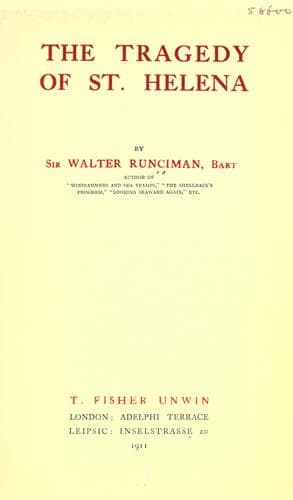
The Tragedy of St. HelenaRunciman, Walter Runciman, Baron
History
The Tragedy of St. Helena
Runciman, Walter Runciman, Baron
Napoleon I, Emperor of the French, 1769-1821 -- Captivity, 1815-1821
It is strange that this keen-sighted man should have yielded up his
own convictions and sunk under the admonitions of less capable judges.
Even so far back as the Directory days, when Bernadotte was insulted
at Vienna, he summed up the Austrian character in the following
terms:--"When the Austrians think of making war, they do not insult;
they cajole and flatter the enemy, so that they may have a better
chance to stick a knife into him." He told the Directory they did not
understand the Cabinet of Vienna; "it is the meanest and most
perfidious to be found." "It will not make war with you because it
cannot." "Peace with Austria is only a truce." His diagnoses were
confirmed by Bernadotte, and more than confirmed in after years. The
marvel is that he did not allow himself to benefit by his shrewd
observations at a moment when so much depended on strength, not
vacillation and weakness.
A vivid justification of the opposition to another Austrian princess
sharing the throne of France is embodied in the lofty ideals (?) of
the Emperor Francis to his daughter Marie Louise at Schoenbrunn after
she had deserted Napoleon. He said to her:--"As my daughter, all that
I have is yours, even my blood and my life; as a sovereign, I do not
know you."
The benediction, pure and big of heart, benignly expressed, is
promptly qualified with kingly sternness; the orthodoxy being that so
long as Napoleon was in power she was his daughter, all that he had
was hers, including his life and blood, but now that he has fallen she
must not thwart his wishes, and loyally share the fate of him who was
the father of her son, who had given her unparalleled glory, and been
so merciful to Francis himself. If she elected to be at all wifely and
cling to her husband in his misfortune, then he would assert the
sovereign, and as readily gore her as he would Napoleon if, in his
patriarchal wisdom, he judged national interests were at stake. His
spirit-crushing rhetoric had a real ultra-monarchical ring about it.
But it was meant for other ears and a purpose other than that of
making his daughter shudder. So far as she was concerned, he might
have saved himself any anxiety on that score. She bowed her head in
conformity, and swiftly cast her amorous eyes on Neipperg, a man after
his and her own heart. This was the culminating event that brought her
destiny with Napoleon to an end, though _he_ tried to avert it, and
the causes are summarised in his own pathetic language, clearly
expressed from time to time.
His nephew, Napoleon III., taking a lesson from his folly, refused to
be buffeted into political matrimony by any of the matchmaking
factions. When his turn came he acted with independence and wisdom by
ignoring the blandishments of meddling advisers and royal
conventionalism, and elected to marry the lady on whom he had set his
affections.
Public-domain text, read in full here on John Shaqi.
Reviews
Reviews
No reviews yet
Be the first to share your thoughts on this work.
Elsewhere in the archive
Join the Discussion
Join the discussion
Sign in to leave a comment or review.
Sign InorCreate an account