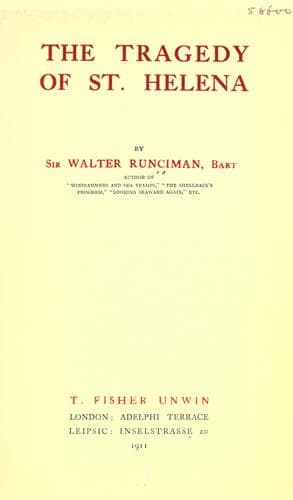
The Tragedy of St. HelenaRunciman, Walter Runciman, Baron
History
The Tragedy of St. Helena
Runciman, Walter Runciman, Baron
Napoleon I, Emperor of the French, 1769-1821 -- Captivity, 1815-1821
[31] It has been asserted that when Josephine found the divorce to be
inevitable she herself suggested the alliance with Marie Louise. One
reason for believing that this might be the case lies in the fact that
the affection of Josephine's children for Napoleon suffered no
diminution on account of the divorce--indeed, Eugene took a leading
part in the negotiations for the marriage.
[32] In the notorious "Letters from the Cape," addressed to Lady
Clavering and variously attributed to an Englishman, Las Cases, and
even Napoleon himself, there is noted a curious coincidence with
regard to the two Franco-Austrian alliances. Both marriage contracts
were signed under somewhat similar circumstances, and in both cases
fetes were held in honour of the event. At the marriage fete of Louis
XVI. and Marie Antoinette a calamity occurred which resulted in the
loss of about two thousand lives. To celebrate the union of Napoleon
and Marie Louise, Prince Schwartzenberg gave a fete, at which a fire
occurred, the Prince's wife and some twenty other people being burnt
to death. The superstitious drew attention to the coincidence, and it
is said that Napoleon looked upon it as an evil omen.
CHAPTER VII
RELIGIOUS NOTIONS OF NAPOLEON
In contrast with members of the oligarchy, who threw all moral
restraints to the winds, Napoleon towers above them. Take any
grounds--administrative, strategical, religious, domestic--he was
preeminent above his contemporaries. On religious grounds alone, those
thoughts of his which have been recorded not only disclose the insight
of a man of affairs, but reveal the thinking mind of a deeply
religious being. His conversations with Gourgaud on religious
subjects, some of which are quoted in Lord Rosebery's admirable book,
"The Last Phase," are so contradictory that they cannot be taken as
authentic beliefs. It greatly depended to whom he was talking as to
the line he took.
It is evident that the Emperor took a delight in arguing with and
contradicting the devout Catholic for sheer intellectual exercise. At
one time he declares to his refractory companion, "If I had to choose
a religion, I would worship the sun, because the sun gives to all
things life and fertility." At another time he torments the Count,
after tying him into a knot and exposing his superficial knowledge, by
saying that "the Mohammedan religion is the finest of all." But when
his mind seriously dwells on sacred things, he declares "that religion
lends sanctity to everything." "The remission of sins is a beautiful
idea." "It makes the Christian religion so attractive that it will
never perish. No one can say 'I do not believe and I never shall
believe.'"
Public-domain text, read in full here on John Shaqi.
Reviews
Reviews
No reviews yet
Be the first to share your thoughts on this work.
Elsewhere in the archive
Join the Discussion
Join the discussion
Sign in to leave a comment or review.
Sign InorCreate an account