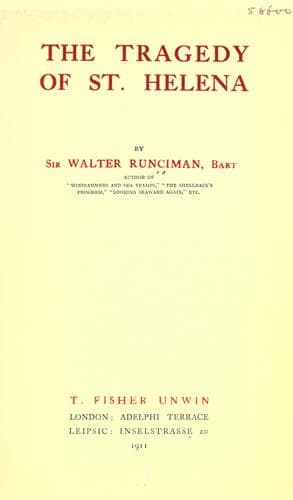
The Tragedy of St. HelenaRunciman, Walter Runciman, Baron
History
The Tragedy of St. Helena
Runciman, Walter Runciman, Baron
Napoleon I, Emperor of the French, 1769-1821 -- Captivity, 1815-1821
Montholon is more to the writer's liking than Gourgaud, even though
Gourgaud's authenticity is backed by Lord Rosebery, and we shall see
later what _he_ says about his Emperor's religious beliefs. It was he
who endeavoured to mitigate his master's mental and physical
sufferings, and it was he whom he desired should close his eyes in
death when the nefarious assassination had been completed. It was he,
too, who got himself locked up in the fortress of Ham for seven years
by adhering steadfastly to the cause of the great exile's nephew.
Gourgaud was loyal and devoted on a sort of sliding scale, which led
him to do great injustice to the stricken hero. Montholon's devotion
was consistent and abiding under all circumstances, while Gourgaud's
fluctuated with his moods.
None of Napoleon's companions in exile were admitted to such close
intimacy with the illustrious warrior-statesman as was Count
Montholon, not even Bertrand or Marchand. It was he who had won
confidence by the most amazing attachment that one human being could
give to another, and it was natural that the big soul of Napoleon
should respond to what amounted to fanatical fidelity. He was the
beloved companion of the Emperor for six years, and during the last
forty-two nights of his life he was with him in the death-chamber, and
at his request he kept vigil and witnessed, his spirit pass away.
It was to him, when the shadow of death was hovering round the smitten
rock, that Napoleon conveyed his most sacred thoughts, domestic,
civil, and religious. He made him one of his executors, bequeathed to
him a fortune, entrusted him with the custody of precious documents,
and to his dying day the recipient of such flattering confidences
never betrayed by word or act the faith that was reposed in him, nor
did he ever falter in his devotion to the martyr's cause. It is from
him we have handed down the famous constitution drawn up by Napoleon
for his son, which is pregnant with democratic wisdom and flows with
the genius of statesmanship. We get, too, a vivid knowledge of the
religious side of Napoleon's versatile character. His talks and
dictations on this controversial subject are unorthodox if you like,
but nevertheless religious; copious in thought and trenchant in
vocabulary, they disclose the magic of a well-stored inspired mind. He
indulges in neither puerilities nor conventionalities. He is a
vigorous student of the Bible and the Koran; he knows his subject, and
speaks his reasonings without reservation, and in the end we see the
vision of the omnipotent God fixed in an enduring belief.
Public-domain text, read in full here on John Shaqi.
Reviews
Reviews
No reviews yet
Be the first to share your thoughts on this work.
Elsewhere in the archive
Join the Discussion
Join the discussion
Sign in to leave a comment or review.
Sign InorCreate an account