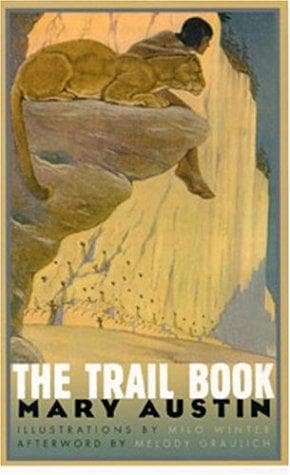
American Museum of Natural History -- Fiction; Indians of North America -- Fiction; Nature stories, American; Western stories
The Pawnees are a roving tribe, in the region of the Platte and Kansas
Rivers. If they were just setting out on their journey when the children
heard them they would sing:--
"Dark against the sky, yonder distant line
Runs before us.
Trees we see, long the line of trees
Bending, swaying in the wind.
"Bright with flashing light, yonder distant line
Runs before us.
Swiftly runs, swift the river runs,
Winding, flowing through the land."
But if they happened to be crossing the river at the time they would be
singing to _Kawas_, their eagle god, to help them. They had a song for
coming up on the other side, and one for the mesas, with long,
flat-sounding lines, and a climbing song for the mountains.
You will find all these songs and some others in a book by Miss Fletcher
in the public library.
TRAIL TALK
You will find the story of the Coyote and the Burning Mountain in my
book _The Basket Woman_.
The Tenasas were the Tennessee Mountains. Little River is on the map.
Flint Ridge is a great outcrop of flint stone in Ohio, near the town of
Zanesville. Sky-Blue-Water is Lake Superior.
Cahokia is the great mound near St. Louis, on the Illinois side of the
river.
When the Lenni-Lenape speaks of a Telling of his Fathers about the
mastodon or the mammoth, he was probably thinking of the story that is
pictured on the Lenape stone, which seems to me to be the one told by
Arrumpa. Several Indian tribes had stories of a large extinct animal
which they called the Big Moose, or the Big Elk, because moose and elk
were the largest animals they knew.
ARRUMPA'S STORY
I am not quite certain of the places mentioned in this story, because
the country has so greatly changed, but it must have been in Florida or
Georgia, probably about where the Savannah River is now. It is in that
part of the country we have the proof that man was here in America at
the same time as the mammoth.
Shell mounds occur all along the coast. No doubt the first permanent
trails led to them from the hunting-grounds. Every year the tribe went
down to gather sea-food, and left great piles of shells many feet deep,
sometimes covering several acres. It is from these mounds that we
discover the most that we know about early man in the United States.
There are three different opinions as to where the first men in America
came from. First, that they came from some place in the North that is
now covered with Arctic ice; second, that they came from Europe and
Africa by way of some islands that are now sunk beneath the Atlantic
Ocean; third, that they came from Asia across Behring Strait and the
Aleutian Islands.
The third theory seems the most reasonable. But also it is very likely
that some people did come from the lost islands in the Atlantic, and
left traces in South America and the West Indies. It may be that Dorcas
Jane and Oliver will yet meet somebody in the Museum country who can
tell them about it.
Public-domain text, read in full here on John Shaqi.
Reviews
Reviews
No reviews yet
Be the first to share your thoughts on this work.
Elsewhere in the archive
Join the Discussion
Join the discussion
Sign in to leave a comment or review.
Sign InorCreate an account