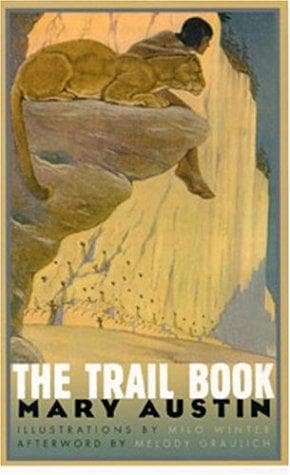
American Museum of Natural History -- Fiction; Indians of North America -- Fiction; Nature stories, American; Western stories
The Great Cold that Arrumpa speaks about must have been the Ice Age,
that geologists tell us once covered the continent of North America,
almost down to the Ohio River. It came and went slowly, and probably so
changed the climate that the elephants, tigers, camels, and other
animals that used to be found in the United States could no longer
live in it.
THE COYOTE'S STORY
_Tamal-Pyweack_--Wall-of-Shining-Rocks--is an Indian name for the Rocky
Mountains. _Backbone-of-the-World_ is another.
The Country of the Dry Washes is between the Rockies and the Sierra
Nevadas, toward the south. A dry wash is the bed of a river that runs
only in the rainy season. As such rivers usually run very swiftly, they
make great ragged gashes across a country.
There are several places in the Rockies called _Wind Trap_. The Crooked
Horn might have been Pike's Peak, as you can see by the pictures. The
white men had to rediscover this trail for themselves, for the Indians
seemed to have forgotten it, but the railroad that passes through the
Rockies, near Pike's Peak, follows the old trail of the Bighorn.
It is very likely that the Indian in America had the dog for his friend
as soon as he had fire, if not before it. Most of the Indian stories of
the origin of fire make the coyote the first discoverer and bringer of
fire to man. The words that Howkawanda said before he killed the Bighorn
were probably the same that every Indian hunter uses when he goes
hunting big game: "O brother, we are about to kill you, we hope that you
will understand and forgive us." Unless they say something like that the
spirit of the animal killed might do them some mischief.
THE CORN WOMAN'S STORY
Indian corn, _mahiz_, or maize, is supposed to have come originally from
Central America. But the strange thing about it is that no specimen of
the wild plant from which it might have developed has ever been found.
This would indicate that the development must have taken place a very
long time ago, and the parent corn may have belonged to the age of the
mastodon and other extinct creatures.
Different tribes probably brought it into the United States at different
times. Some of it came up the Atlantic Coast, across the West Indies.
The fragments of legend from which I made the story of the Corn Woman
were found among the Indians that were living in Virginia, Kentucky, and
Tennessee at the time the white men came.
Chihuahua is a province and city in Old Mexico, the trail that leads to
it one of the oldest lines of tribal migration on the continent.
To be given to the Sun meant to have your heart cut out on a sacrificial
stone, usually on the top of a hill, or other high place. The Aztecs
were an ancient Mexican people who practiced this kind of sacrifice as a
part of their religion. If it was from them the Corn Woman obtained the
seed, it must have been before they moved south to Mexico City, where
the Spaniards found them in the sixteenth century.
A _teocali_ was an Aztec temple.
Public-domain text, read in full here on John Shaqi.
Reviews
Reviews
No reviews yet
Be the first to share your thoughts on this work.
Elsewhere in the archive
Join the Discussion
Join the discussion
Sign in to leave a comment or review.
Sign InorCreate an account