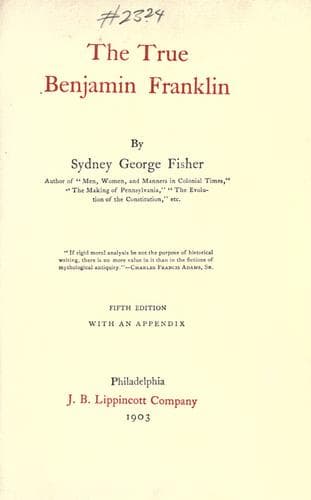
This analysis of the life and character of Franklin has in view a
similar object to that of the volume entitled “The True George
Washington,” which was prepared for the publishers by Mr. Paul Leicester
Ford and issued a year or two ago.
Washington sadly needed to be humanized, to be rescued from the
myth-making process which had been destroying all that was lovable in
his character and turning him into a mere bundle of abstract qualities
which it was piously supposed would be wholesome examples for the
American people. This assumption that our people are children who must
not be told the eternal truths of human nature, but deceived into
goodness by wooden heroes and lay figures, seems, fortunately, to be
passing away, and in a few years it will be a strange phase to look back
upon.
So thorough and systematic has been the expurgating during the last
century that some of its details are very curious. It is astonishing how
easily an otherwise respectable editor or biographer can get himself
into a state of complete intellectual dishonesty. It is interesting to
follow one of these literary criminals and see the minute care with
which he manufactures an entirely new and imaginary being out of the
real man who has been placed in his hands. He will not allow his victim
to say even a single word which he considers unbecoming. The story is
told that Washington wrote in one of his letters that a certain movement
of the enemy would not amount to a flea-bite; but one of his editors
struck out the passage as unfit to be printed. He thought, I suppose,
that Washington could not take care of his own dignity.
Franklin in his Autobiography tells us that when working as a journeyman
printer in London he drank nothing but water, and his fellow-workmen, in
consequence, called him the “Water-American;” but Weems in his version
of the Autobiography makes him say that they called him the “American
Aquatic,” an expression which the vile taste of that time was pleased to
consider elegant diction. In the same way Temple Franklin made
alterations in his grandfather’s writings, changing their vigorous
Anglo-Saxon into stilted Latin phrases.
It is curious that American myth-making is so unlike the ancient
myth-making which as time went on made its gods and goddesses more and
more human with mortal loves and passions. Our process is just the
reverse. Out of a man who actually lived among us and of whose life we
have many truthful details we make an impossible abstraction of
idealized virtues. It may be said that this could never happen among a
people of strong artistic instincts, and we have certainly in our
conceptions of art been theatrical and imitative rather than dramatic
and real. Possibly the check which is being given to our peculiar
myth-making is a favorable sign for our art.
Public-domain text, read in full here on John Shaqi.
Reviews
Reviews
No reviews yet
Be the first to share your thoughts on this work.
Join the Discussion
Join the discussion
Sign in to leave a comment or review.
Sign InorCreate an account