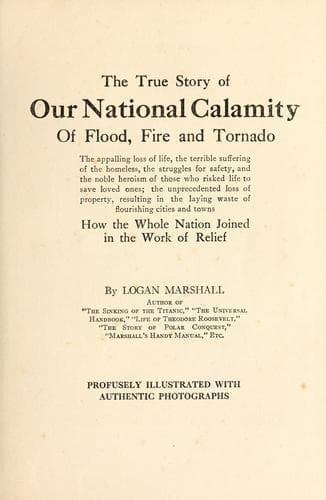
The True Story of Our National Calamity of Flood, Fire and TornadoMarshall, Logan
History
The True Story of Our National Calamity of Flood, Fire and Tornado
Marshall, Logan
Floods -- Ohio River Valley; Omaha (Neb.) -- Tornado, 1913
The steel suspension bridge, two hundred feet in length, across the
Hudson between the city and South Glens Falls was destroyed. All records
for high water were broken, the bridge being carried out after the steel
supports underneath had been constantly pounded for hours by logs dashed
against them by the raging waters.
At Hadley, one of the plants of the Union Bag and Paper Company was
completely flooded, and water was pouring from every window. It was
feared that the structure might be destroyed. All paper mills in the
section were closed down.
DISTRESS IN FORT EDWARD
At Fort Edward village $50,000 damage was done. About one hundred
families were driven from their homes to seek shelter in higher parts of
the village. Many parts of the village were submerged and in the main
business section five feet of water filled the cellars on the river side
of the street. The water had reached the windows of the first stories of
many houses in the lower sections. Trains of loaded coal cars were used
to hold down the monster railroad bridge of the Delaware and Hudson
Company at this village while big jams of logs threatened to carry it
out.
BIG PAPER COMPANY IN TROUBLE
At least 150 feet of the big dam of the International Paper Company at
Corinth was carried out and the mill partly flooded. A small part of the
same company's dam at Fort Edward was also carried out. The
International was one of the heaviest losers.
HOMES ABANDONED IN SCHENECTADY
At Schenectady, just west of the Hudson on the Mohawk, houses on
twenty-five streets were abandoned by their occupants. The entire lower
section of the city was submerged.
The whole Mohawk Valley was swept by the worst flood in its history.
The Groff dam near Herkimer broke and several houses were carried away.
A dam at Canajoharie threatened to go out. Three great canal gates at
Fort Plain were swept away. The Amsterdam reservoir, which covers 680
acres, was weakened and a patrol was stationed there.
HIGH WATERS IN TROY
So great was the flood in Troy, on the Hudson below the entrance of the
Mohawk, that martial law was practically declared. Members of two
military companies patrolled the streets, relieving the tired firemen
and police, many of whom had been on continuous duty for forty-eight
hours. Mayor Burns did not sleep for two nights, taking charge in person
of the Public Safety Department.
Fires added to the seriousness of the flood situation and firemen were
kept busy all day answering alarms in the flooded district. Damage
estimated at thousands of dollars was done by the fire.
For the first time in the history of Troy the newspapers, with one
exception, were unable to go to press. One publication printed a
four-page pamphlet on a hand press. Another was printed in Albany.
Hundreds of families were rendered homeless, and relief stations in
various parts of the city were filled with refugees. The city faced an
epidemic of typhoid, and every effort was made to guard against it.
Public-domain text, read in full here on John Shaqi.
Reviews
Reviews
No reviews yet
Be the first to share your thoughts on this work.
Elsewhere in the archive
Join the Discussion
Join the discussion
Sign in to leave a comment or review.
Sign InorCreate an account