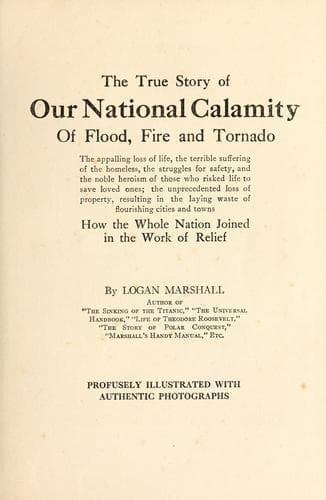
The True Story of Our National Calamity of Flood, Fire and TornadoMarshall, Logan
History
The True Story of Our National Calamity of Flood, Fire and Tornado
Marshall, Logan
Floods -- Ohio River Valley; Omaha (Neb.) -- Tornado, 1913
[Illustration: Copyright by International News Service.
One of the victims of the tornado at Omaha was picked up by the tornado
and his corpse left suspended in the broken and twisted limbs of a
tree]
WORST FLOOD IN HISTORY OF HORNELL
Following thirty hours of continued rain, Hornell, a small city in
Steuben County, suffered the worst flood in its history. It swept down
the Canisteo Valley, completely inundating the greater portion of the
city of Hornell and half a dozen villages within a radius of ten miles.
A thousand homes were flooded.
The Canisteo Valley for a distance of forty miles was under water, and
the situation was appalling. Roads were washed out, bridges gone and
much property destroyed. The fire in every furnace in the flood district
was out, and suffering was acute.
LAKE COUNTRY PARALYZED WITH FEAR
The lake region in the central western part of the state suffered
heavily from floods. The villages of Marcellus, Camillus and Marietta,
west of Syracuse, were threatened with extinction. The earthen bank,
which adjoins the huge dam of Otisco Lake, weakened and, it was feared
that if the flood conditions did not improve the bank would give way.
Auburn was seriously threatened by the rising of Owasco Lake. The dam
furnishing power to the Dunn and McCarthy shoe shops broke in the center
and it was feared the rest of the structure would go down. Pumps were at
work continuously in the Auburn water works at Owasco Lake to keep the
engine and boiler pits free of water.
The Lehigh Valley Railroad along Cayuga Lake, between Auburn and Ithaca,
was under water for a distance of nine miles south of Kings Ferry. No
trains were running on that branch. A small bridge at Farley's Point,
near the lower end of Cayuga Lake, was washed away. An avalanche of mud
and stones buried the railroad tracks near Kings Ferry.
The incessant rains of two days raised the little creeks in the vicinity
of Interlaken to torrents. Many bridges were washed out.
Canandaigua Lake reached its highest level in sixteen years. Streets in
Canandaigua were flooded.
Floods due to breaks and overflows in the Erie Canal at Waterloo, Seneca
Falls, Port Bryon and elsewhere, caused thousands of dollars loss. The
Seneca River was over its banks.
WATER COVERS PART OF BINGHAMTON
At Binghamton, on the Susquehanna River, water covered the entire
northwestern residence section of the city. All the manufacturing
establishments along the river banks were closed.
Boats were forced into use in the residence districts and the Fire
Department, with three steamers, endeavored to keep down the water in
the basements in the business section.
GLENS FALLS BRIDGE DOWN
But more serious than the conditions anywhere else in New York were
those along the Hudson River Valley. Damage estimated at not less than
$300,000 was caused by high water near Glens Falls, resulting from heavy
rains, which fell for nearly a week.
Public-domain text, read in full here on John Shaqi.
Reviews
Reviews
No reviews yet
Be the first to share your thoughts on this work.
Elsewhere in the archive
Join the Discussion
Join the discussion
Sign in to leave a comment or review.
Sign InorCreate an account