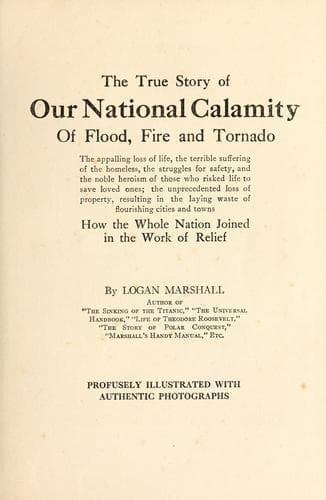
The True Story of Our National Calamity of Flood, Fire and TornadoMarshall, Logan
History
The True Story of Our National Calamity of Flood, Fire and Tornado
Marshall, Logan
Floods -- Ohio River Valley; Omaha (Neb.) -- Tornado, 1913
The crest of the Ohio river flood reached Louisville April 1st, with a
stage of about forty-five feet.
The railroad situation in Louisville became acute. The Louisville,
Henderson and St. Louis suspended traffic entirely. The Louisville and
Nashville from Cincinnati could reach the city only by detouring through
Jeffersonville, Indiana, crossing the swollen Ohio on the Big Four
bridge and returning via the Pennsylvania bridge to reach the Louisville
and Nashville station, which was used also by the Pennsylvania trains.
[Illustration: Copyright by American Press Association.
Scene showing a section of Omaha entirely wrecked. On the left is all
that remains of Idlewild Hall. At this spot a large number of people
were killed]
[Illustration: Copyright by the International News Service.
A typical scene at one of the relief stations. Here men, who a few hours
before had been millionaires, stood in line with their fellow citizens,
quite as much dependent on these relief stations for sustenance as
paupers. Orville Wright, the famous aviator, was one of the men in the
bread line]
Western Kentucky points continued to report rising water. Owensboro,
Henderson and Wickliffe were centers of refuge for inhabitants of the
lowlands, who fled before the flood. There were more than four thousand
refugees at Wickliffe.
At Paducah on April 3d the flood situation was rendered doubly grave by
the fact that smallpox had broken out in the camp of colored refugees on
Gregory Heights. Five hundred on the hill had been quarantined.
IMPERILED TOWNS IN INDIANA
The government relief boat "Scioto," in command of Lieutenant Hight, U.
S. A., towed a barge load of provisions into Lawrenceburg, Indiana, on
March 31st, to find but forty of the five thousand homes there not under
water. When the boat proceeded to Aurora conditions were found almost as
bad, with but five hundred homes free from the reach of the
all-engulfing waters.
The south levee at Lawrenceburg broke at 2.50 P. M. on March 29th. A
wall of water poured through the opening and went raging through the
center of the town, tearing up all before it. Houses were crushed like
eggshells and the wreckage was carried four miles along the Miami to the
fill on the main line of the Big Four. The break came when it was least
expected, but the residents were warned to leave town, and no lives were
lost. Water stood six feet deep in the streets.
JEFFERSONVILLE AND EVANSVILLE FLOODED
At Jeffersonville two hundred convicts from the Indiana Reformatory
worked for nearly two days on the levee during the flood week, and
through their work it was possible to save the town from the Ohio River.
A committee of citizens of Jeffersonville perfected arrangements for a
banquet to be given in honor of the gray-garbed men who saved their
homes. The entertainment was planned for April 13th, at a cost of
$1,000.
Public-domain text, read in full here on John Shaqi.
Reviews
Reviews
No reviews yet
Be the first to share your thoughts on this work.
Elsewhere in the archive
Join the Discussion
Join the discussion
Sign in to leave a comment or review.
Sign InorCreate an account