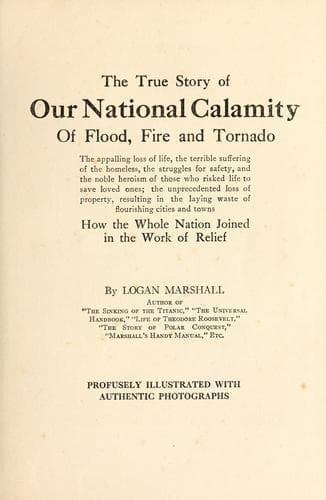
The True Story of Our National Calamity of Flood, Fire and TornadoMarshall, Logan
History
The True Story of Our National Calamity of Flood, Fire and Tornado
Marshall, Logan
Floods -- Ohio River Valley; Omaha (Neb.) -- Tornado, 1913
Evansville citizens were alarmed at the continued rise of the Ohio, and
all movables were carried to places of certain safety. On April 1st, the
Government took charge of the flood situation. Captain W. K. Naylor
hastened to commandeer steamboats and patrol the river to pick up flood
sufferers. Mayor Charles Heilman left for Mount Vernon to take charge of
rescue work in that section.
Thirty thousand persons within a radius of ninety miles around Mount
Vernon were calling for help on April 4th.
The Howell levee, protecting two hundred families in Ingleside, between
Evansville and Howell, gave way and the Ingleside district was inundated
with depths of from six to ten feet. Minutemen had been posted all long
the dangerous dike, and when the water began to pour over the top an
alarm was sounded and all escaped.
SHAWNEETOWN SUBMERGED
Shawneetown, Illinois, was entirely cut off from the outside world. On
the night of April 1st, the water in the streets was twelve feet deep.
After another twenty-four hours, all that was left of Shawneetown were
the few substantial brick and stone buildings behind the main levee, and
they were considered unsafe. Less than one hundred persons remained in
the former town of three thousand, and they were perched in the second
and third stories of Main Street buildings, structures on the highest
street in the town. A strong wind completed the destruction begun by the
opening of the levee.
CAIRO FACING CRISIS
As usual, Cairo feared the worst from the on-sweeping flood of the Ohio
River. The Cairo executive flood committee late on March 30th sent an
appeal to President Wilson asking for aid for Cairo and towns nearby:
"The worst flood ever known in the Ohio Valley and the Mississippi is
now expected. All previous records at Cairo and south may be broken in a
few days. We are making every effort in our power to take care of local
situation, but the river communities near us should have assistance.
Boats, sacks, food and other supplies are needed. May we not have the
help of your great office for this district?"
The Big Four levee, which protected the "drainage district," went out on
April 1st. It was about five miles north of the city. Accordingly, as
workmen were able to battle no longer with the levee situation in the
drainage district, they were brought into Cairo and set to work along
the river front. The state troops were sent in squads of five, each
accompanied by a policeman, to visit the rendezvous of men who were
unwilling to or had refused to work.
All places of business which did not handle goods needed for the comfort
and necessities of the people were closed in order to give opportunity
to get out the strongest working force possible. Employees of closed
concerns responded willingly for duty and reinforced to a great extent
the work along the river front.
Public-domain text, read in full here on John Shaqi.
Reviews
Reviews
No reviews yet
Be the first to share your thoughts on this work.
Elsewhere in the archive
Join the Discussion
Join the discussion
Sign in to leave a comment or review.
Sign InorCreate an account