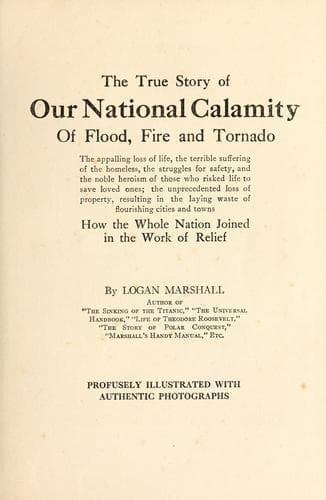
The True Story of Our National Calamity of Flood, Fire and TornadoMarshall, Logan
History
The True Story of Our National Calamity of Flood, Fire and Tornado
Marshall, Logan
Floods -- Ohio River Valley; Omaha (Neb.) -- Tornado, 1913
In explaining why the river from Vicksburg to the mouth of the river
would be higher than last year, Captain Sherrill pointed to the fact
that crevasses both below and above the stretch in 1912 lowered the
river there, whereas upon the present rise, with levees expected to
confine the water, the crest naturally would be higher. Because of this
fact the brunt of the high water was expected to strike that stretch,
and any possible trouble to be looked for could be expected there,
although the levees between Old River and Baton Rouge might also be in
danger.
RISING HOPE
The hopes of the people began to rise as they learned that the entire
Mississippi levee system was to be made two feet higher than the record
of the flood last year. It was expected the work would be completed
before the crest of the Ohio River flood reached the lower Mississippi
Valley.
On receipt of reports that two hundred families had been driven from
their homes in the lowlands of the Atchafalaya River, near Breaux
Bridge, Louisiana, owing to high water, and were in a destitute
condition, local relief committees from New Orleans rushed a large
quantity of supplies to that section.
The appeal said if immediate aid was not received it was feared many
would die of starvation. Inhabitants of the district were principally
foreigners, who had reclaimed a part of their truck farms, which were
destroyed by last year's flood. Their newly planted crops were
abandoned.
A NATIONAL PROBLEM
It is a curious fact that the Mississippi has done as much to kill the
old doctrine of states' rights as any other influence. For instance,
Louisiana, after spending thirty millions of dollars on river problems,
was quite willing to concede that the Mississippi was a national affair
and that Federal aid was altogether desirable. But it is plain that the
resources of the individual states as well as of the nation must be
utilized for the prevention of floods. This is a task so vast that a
united effort is required.
CHAPTER XXX
DAMAGE TO TRANSPORTATION, MAIL AND TELEGRAPH FACILITIES
GREAT DAMAGE AND WASHOUTS--TICKETS SOLD SUBJECT TO DELAY--REPORTS OF
TRACKS GONE--PENNSYLVANIA RAILROAD A HEAVY SUFFERER--HEAVY LOSS ON
BALTIMORE AND OHIO--ESTIMATED DAMAGE--FLOOD PLAYED HAVOC WITH
MAILS--GENERAL PROSTRATION OF TELEGRAPH AND TELEPHONE WIRES.
Only one railroad was working between New York and Chicago on the night
of Wednesday, March 26th. That was the Lake Shore and Michigan Southern.
Over the line were speeding the trains of the New York Central and
allied lines, the Pennsylvania, the Baltimore and Ohio, and the Erie,
passenger and freight service combined. Many trains were derailed in
flooded territories.
The following bulletin was given out at the office of W. C. Brown,
president of the New York Central Railroad:
Public-domain text, read in full here on John Shaqi.
Reviews
Reviews
No reviews yet
Be the first to share your thoughts on this work.
Elsewhere in the archive
Join the Discussion
Join the discussion
Sign in to leave a comment or review.
Sign InorCreate an account