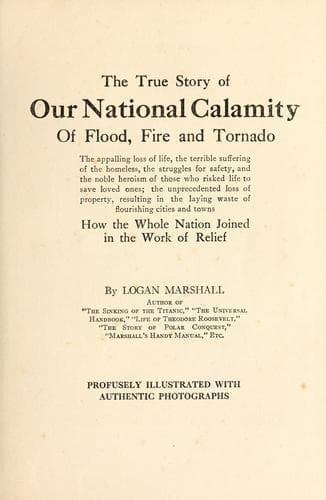
The True Story of Our National Calamity of Flood, Fire and TornadoMarshall, Logan
History
The True Story of Our National Calamity of Flood, Fire and Tornado
Marshall, Logan
Floods -- Ohio River Valley; Omaha (Neb.) -- Tornado, 1913
It was not for any selfish purpose that the roads threw this immense
power into the work. Their object was to open up rail communication
with the desolated cities, towns and villages and send relief trains
with bread, with blankets, with medicines, doctors and nurses. It was
not a race for money.
"We will carry every pound of supplies for the devastated district free
over any lines" announced the Pennsylvania, and it added free passage
for doctors, nurses and every other good Samaritan.
"No charge," was the echo of the New York Central, and that order went
to every freight and passenger agent of the big system everywhere. The
Baltimore and Ohio, the Erie, and every other line followed in an
instant. The railroads helped all they could.
RELIEF FROM STATES AND INDIVIDUALS
If the nation was generous and prompt in its relief, neighboring states
and individuals were not less so. Governors in many states and mayors of
many cities, following the noble example of the President, issued
appeals for help. Mayor Dahlman of Omaha and Governor Morehead of
Nebraska bravely declined the help offered by President Wilson and
others for sufferers from the tornado; but the flood-stricken districts,
for whom recovery was far less easy, in many cases were obliged to
appeal for aid. From towns throughout Ohio and Indiana came desperate
cries for help, and to all of them a sympathetic nation listened and
responded.
AN ARMY OF PEACE
If the great calamity stirred the hearts of the nation with pity, so did
the prompt and splendid relief inspire enthusiasm. Even though the
despatch of United States troops to the scene of devastation in the West
lacked legal sanction the whole country unanimously approved the
movement which thus itself becomes a signal to all nations, and a
corroboration of the truth that the American is not hidebound by
fantastic traditions when some serious achievement is to be done. Our
soldiers in this case for the nonce became missionaries. Under the
leadership of the Secretary of War, the troops carried clothes, food,
medicaments, tents, blankets, and in short all the paraphernalia
necessary to succor the distressed, assuage the pangs of suffering and
restore normal conditions within the wide areas battered by the
destructive elements.
This peaceful use of our fighting men brings into realization the vision
so strongly cherished by John Ruskin--the vision of the time when
soldiership should develop into a form of modern knight-errantry, and
the "passion to bless and save" should inspire those who were formerly
drilled only in the exercises of conquest and slaughter. Americans may
well be proud to reflect that this era, which a few decades ago seemed
but the chimerical dream of a doctrinaire, has found its pledge and
promise in the generous endeavors of our standing army.
"Peace hath her victories no less renowned than war."
Public-domain text, read in full here on John Shaqi.
Reviews
Reviews
No reviews yet
Be the first to share your thoughts on this work.
Elsewhere in the archive
Join the Discussion
Join the discussion
Sign in to leave a comment or review.
Sign InorCreate an account