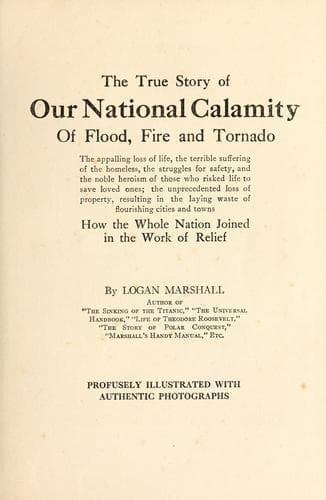
The True Story of Our National Calamity of Flood, Fire and TornadoMarshall, Logan
History
The True Story of Our National Calamity of Flood, Fire and Tornado
Marshall, Logan
Floods -- Ohio River Valley; Omaha (Neb.) -- Tornado, 1913
In narrowing the dimension of suffering, and lending a strong hand to
those overwhelmed by calamity, our soldiers raised up the defeated from
the sore battle of life.
CHAPTER XXXII
PREVIOUS GREAT FLOODS AND TORNADOES
THE JOHNSTOWN HORROR--THE GALVESTON TRAGEDY--THE MISSISSIPPI ON A
RAMPAGE--DESTRUCTION IN LOUISVILLE--THE ST. LOUIS TORNADO.
Floods are not usually so dramatic and awe-inspiring as tornadoes, but
they are even more destructive of life. The Johnstown flood of 1889,
however, was dramatic and even spectacular--so swiftly did it come and
so certainly could it have been avoided. It destroyed 2,235 lives, swept
away ten millions of dollars worth of property, and carried unutterable
grief into countless happy homes.
Lying in a narrow valley were eight villages, aggregating 50,000 to
80,000 inhabitants, the largest of the eight being situated at the lower
end, with about 25,000 inhabitants.
Far up in the mountain, 300 feet above the chief village of the valley,
hung a huge body of water. As nature had designed it, this had been a
small lake with natural outlets, which prevented it from being a menace
to the valley below. But the hand of man sought to improve the work of
nature. An immense dam, 110 feet in height, held back the water till the
lake was more than quadrupled in size.
THE SWOLLEN WATERS
These were the conditions on May 31, 1889. There had been heavy rains
for several days. The artificially enlarged lake was really a receiving
reservoir of the water-shed of the Alleghany Mountains. Every little
stream running into it was swollen to a torrent. The lake, which in
ordinary times was three and a half miles long, with an average width of
over a mile, and a depth in some portions of 100 feet, was swollen into
a volume of water of enormous proportions. Between it and the valley
below there was a dam nearly 1,000 feet wide, 100 feet high, ninety feet
thick at the base and twenty at the top. This barrier gave way and the
water rushed into the valley in a solid wave with a perpendicular front
of forty feet.
It swept away the seven smaller villages like straw, hurled them,
together with uncounted thousands of their inhabitants, upon the larger
village, and then, with the accumulated ruin of the whole eight, dashed
upon the stone bridge at the bottom of the valley. The bridge withstood
the shock, and a new dam, as fateful with horror as the first had been,
was formed. It held back the water so that the whole valley was a lake
from twenty to forty feet in depth, with the remains of its villages
beneath its surface. The wreckage of the ruined villages, piled from
forty to sixty feet high, against the bridge, spread over a vast area,
with countless bodies of the living and the dead crushed within it and
struggling for life upon it, caught fire, and burned to the water's
edge.
Public-domain text, read in full here on John Shaqi.
Reviews
Reviews
No reviews yet
Be the first to share your thoughts on this work.
Elsewhere in the archive
Join the Discussion
Join the discussion
Sign in to leave a comment or review.
Sign InorCreate an account