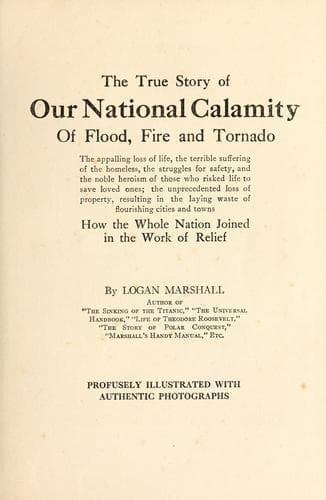
The True Story of Our National Calamity of Flood, Fire and TornadoMarshall, Logan
History
The True Story of Our National Calamity of Flood, Fire and Tornado
Marshall, Logan
Floods -- Ohio River Valley; Omaha (Neb.) -- Tornado, 1913
Everything it touched suffered. Church steeples fell, crushing beneath
their weight the buildings over which they had stood guard. Wrenching
warehouses to fragments the tornado passed to the river front, leaving a
broad swath of wreckage and dead bodies. The belt of destruction
extended from the west side of Seventh Street as far as Ninth and Main
Streets, and an equal width across to the point where the city was first
touched. Along this path were demolished homes and wrecked business
houses--the annihilated work of years. On the river the storm found full
sway. The tawny water of the swollen Ohio became a lake of seething
foam. Steamboat after steamboat was driven from its moorings and tossed
like a drop of spray in the boiling stream.
CITIZENS MADDENED WITH GRIEF
Almost immediately after the storm had passed thousands crowded into the
distressed district; maddened men and women fought and struggled through
the debris trying to find some loved relative or friend. From every side
arose the groans of the wounded and dying. About the Falls City Hotel
groups thronged waiting for news.
Fires burning in several places added to the horror, though no great
damage was done by these. Crushed and blackened ruins marked the spot of
the Union Depot, which collapsed during the storm, crushing a train
which was just ready to depart. Every building, tree and telegraph pole
in the district struck was leveled, and almost all the railroads
entering the city were obliged to suspend all passenger and freight
traffic.
RESCUE, RELIEF AND RECONSTRUCTION
The work of rescuing the mangled dead was bravely carried on the
following day and before many hours the American genius for
organization, order and action had met the demands of the overwhelming
disaster. While the dead were still lying awaiting burial, plans were
made to rebuild and resume again the work of life.
The local police and militia kept order. The city authorities and board
of trade organized relief corps. The brave spirit of self-reliance
triumphed over the appalling calamity. Money for relief was sent to the
city from many sources, and it is interesting to note that the citizens
of Johnstown, who had suffered from the great catastrophe of the
previous year, were among the first to offer help. They knew what
desolation meant.
THE ST. LOUIS TORNADO
A far more terrible story of death and destruction is that of the St.
Louis tornado of May 27, 1896, which lasted but half an hour, killed 306
persons and destroyed property to the amount of $12,000,000.
The same tornado visited many places in Missouri and Illinois, causing
an additional property loss of $1,000,000.
Public-domain text, read in full here on John Shaqi.
Reviews
Reviews
No reviews yet
Be the first to share your thoughts on this work.
Elsewhere in the archive
Join the Discussion
Join the discussion
Sign in to leave a comment or review.
Sign InorCreate an account