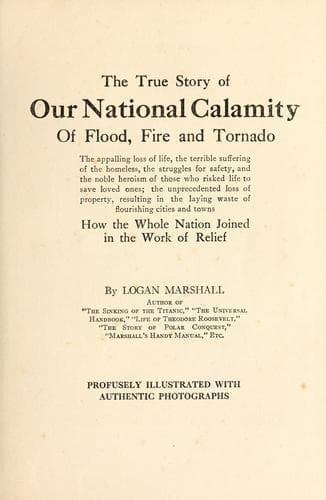
The True Story of Our National Calamity of Flood, Fire and TornadoMarshall, Logan
History
The True Story of Our National Calamity of Flood, Fire and Tornado
Marshall, Logan
Floods -- Ohio River Valley; Omaha (Neb.) -- Tornado, 1913
The sky grew black at 4 P. M., the sun was eclipsed in the whirl of
driving dust and dirt, mingled with the branches and leaves of trees,
the boards of buildings and other loose material torn off by the wind.
At times the wind blew eighty miles an hour. In that mad half hour,
while property was crumbling and hundreds of human lives being snuffed
out, thousands of maimed and bleeding persons were added to the awful
harvest of devastation.
FREAK DESTRUCTION
Over in East St. Louis, where the houses were all frail structures, the
destruction was greatest. The great Eads Bridge was twisted all out of
shape, and freight cars were tossed to and fro, tumbled into ditches and
driven sometimes into the fields many yards from where they had stood.
The great Vandalia freight house fell in a heap of utter ruin, burying
beneath it thirty-five men who had there sought refuge.
The swath cut was three blocks wide and four miles long. The top of the
bridge was knocked off as well as the big abutment. The Martell House
was blown into the Cokokia Creek and many were buried in the ruins.
To add to the horrors of the night the electric-light plants were
rendered incapable of service, and the gas lamps were also shut off,
leaving the city in utter darkness. Fire broke out in several portions
of the city, and the fire department was unable to make an effective
fight because of the choked condition of the streets and the large
number of firemen who were engaged in the imperative work of rescuing
the dead and wounded.
ANNIHILATION
The City Hospital, which fortunately survived the storm, was filled to
overflowing with the injured. In addition to those who were killed in
their houses and in the streets, scores of dead were carried away by the
waters of the Mississippi River. Many steamers on the levee went down
in the storm. From the "Great Republic," one of the largest steamers on
the lower river, not a man escaped. The word "annihilation" is perhaps
the only one that can adequately describe the awful work of the tornado.
The rising of the sun in the morning revealed a scene of indescribable
horror. The work of carrying out the maimed and dead immediately began,
but it was a task of big proportions, as many bodies were totally buried
under the debris. Hundreds of families were rendered homeless, and the
business portion of the community was almost in absolute ruin.
Lack of food added to the misery. Bread sold for fifteen cents a loaf. A
large number of military tents were shipped into the city and many
families found shelter in freight yards. The Ohio and Mississippi
railroad companies issued permits for the use of their empty cars.
Contributions to aid in the work of rebuilding and relief were received
and the city council voted $100,000.
Public-domain text, read in full here on John Shaqi.
Reviews
Reviews
No reviews yet
Be the first to share your thoughts on this work.
Elsewhere in the archive
Join the Discussion
Join the discussion
Sign in to leave a comment or review.
Sign InorCreate an account