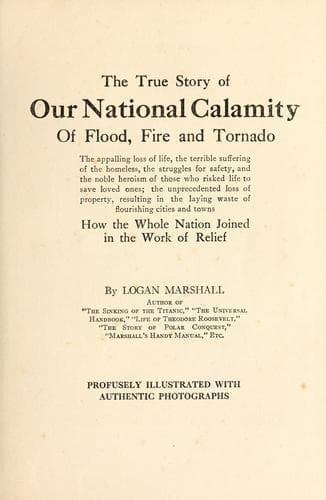
The True Story of Our National Calamity of Flood, Fire and TornadoMarshall, Logan
History
The True Story of Our National Calamity of Flood, Fire and Tornado
Marshall, Logan
Floods -- Ohio River Valley; Omaha (Neb.) -- Tornado, 1913
The thing that made the situation most difficult for concerted rescue
work was the peculiar geographical situation of the town. It is divided
into six sections: central Dayton, comprising the down-town business
district; West Dayton, the territory extending several miles west of the
big Miami; Riverdale, the northeast, across the river from the central
district; Dayton View, the extreme northeast; Southern Dayton, the
manufacturing district in which the National Cash Register Company's
plant is located and separated from the central district by lowlands
which were deep in flood water, and North Dayton, northwest of the
business district, across the river from the business section.
PITIABLE CONDITION OF MAROONED
The river forms a horseshoe around the business district, making it
impossible to reach that part until the torrents that poured down the
valley should recede.
Dayton View, West Dayton and Riverdale were the only sections between
which communication was possible.
The suburb of Riverdale up to Helena Street was penetrated by the
down-town relief commission and conditions found much similar to those
in the southern suburbs. Everyone was crowded to the second floors or
roofs of their homes, but few of the more stable dwellings were washed
away.
North of Burns Avenue as far as Fourth Street the water was found to be
from three to six feet deep. Beyond Fourth Street the water had receded
to make it possible in many places to proceed on foot.
Nothing was known of the foreign settlement in North Dayton close to the
Miami River. It was this part of the city where the flood first made its
way and where the occupants of the houses had ignored warnings to
leave. It was here also that it was feared most of the deaths would
occur. The only body found on Thursday was that of Charles Parker, a
livery man, discovered in the court house yard.
Captain of Police H. E. Lackhart declared that water in North Dayton,
Miami City and East Dayton reached the housetops. His estimate of the
number of dead in that district was three hundred.
The bodies of a woman and a baby were seen floating down Jefferson
Street, one of Dayton's main thoroughfares. It was thought that they
came from the district north of the river.
A report which had been current in the water district south of Main
Street that Brigadier-General Wood had been fatally injured by falling
plate glass, proved to be untrue. He continued in full charge of the
relief work, although his arm had been badly cut.
Parts of Main Street were impassable because of debris. At several
points it comprised outbuildings that had struck more stable buildings
and been dashed to pieces.
Hourly apprehension for the appalling sights to be uncovered when the
waters return to normal was growing.
PLANS FOR FIGHTING PESTILENCE
Public-domain text, read in full here on John Shaqi.
Reviews
Reviews
No reviews yet
Be the first to share your thoughts on this work.
Join the Discussion
Join the discussion
Sign in to leave a comment or review.
Sign InorCreate an account