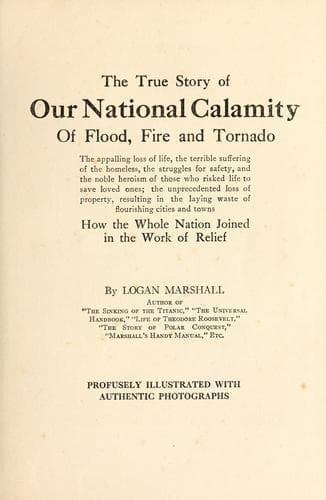
The True Story of Our National Calamity of Flood, Fire and TornadoMarshall, Logan
History
The True Story of Our National Calamity of Flood, Fire and Tornado
Marshall, Logan
Floods -- Ohio River Valley; Omaha (Neb.) -- Tornado, 1913
After having descended the Miami River, Captain Gillooly reported that
in the south central section of Dayton, where the flood flowed wildest
on Tuesday night and Wednesday, thousands of persons still were
imprisoned in upper floors of their homes. He stated that from numerous
inquiries among people whose residences had been inundated it appeared
the life loss would not be nearly so large as it was placed by first
reports.
This section still was flooded, although the water rapidly was receding,
and while a few corpses eddied out from the flood's edge, yet in the
center of the area it was stated that only two bodies had been seen.
DRINKING WATER DISTRIBUTED
Captain Gillooly and his men distributed food and quantities of drinking
water to a large number of the flood's prisoners. Arrangements also were
made to provide the needy ones with the necessary supplies from time to
time until the flood waters receded.
At many different points along the route stops were made and the crew
detoured away from the rivers. It was found that many of these detours
could be made afoot, the water having rapidly fallen since the night. At
no place was the water behind the levees deeper than four feet.
The Louisville men took relief to several hundred families in the low
district in the vicinity of Ludlow and Franklin Streets. Here the water
had reached the roofs of all two-story buildings. Only a few of the most
desperate cases were brought out, the first move being to leave bread
and water in as many places as possible.
Sixty Catholic sisters at the Academy of the Sisters of Notre Dame and
eighteen persons for whom they had provided refuge were found to have
been without food or water since Tuesday. There were several cases of
illness, and the suffering had been intense. The life savers left bread
and water and planned to take further help.
Meanwhile Capt. H. A. Hansen and the crew from Cleveland were operating
several boats in North Dayton. There many of the poorer class live, and
few of the buildings were substantial. Dozens of them were swept away,
upturned and shattered.
Mayor Phillips was still marooned in his house, and G. B. Smith,
president of the Chamber of Commerce, continued in active aid of relief
operations.
The Fourth National Bank Building, which was reported several times to
have been destroyed by fire, was found untouched by the flames, although
a building immediately adjoining was burned. The newspaper offices, the
_News_ and _Herald_ and _Journal_ buildings, were safe, but none was
issuing papers.
Public-domain text, read in full here on John Shaqi.
Reviews
Reviews
No reviews yet
Be the first to share your thoughts on this work.
Join the Discussion
Join the discussion
Sign in to leave a comment or review.
Sign InorCreate an account