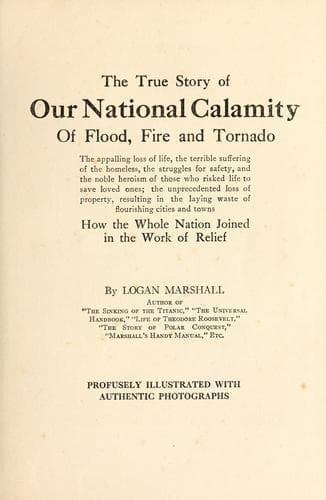
The True Story of Our National Calamity of Flood, Fire and TornadoMarshall, Logan
History
The True Story of Our National Calamity of Flood, Fire and Tornado
Marshall, Logan
Floods -- Ohio River Valley; Omaha (Neb.) -- Tornado, 1913
But the flood did not confine itself to Dayton. It laid its watery hand
of death and destruction over a whole tier of states from the Great
Lakes to New England, and over the vast area to the southward which is
veined by the Ohio River and its tributaries, and extending from the
Mississippi Valley almost to the Atlantic seaboard. And as this awful
deluge drained from the land into Nature's watercourses the demons of
death and devastation danced attendance on its mad rush that laid waste
the borderlands of the Mississippi River from Illinois to the Gulf of
Mexico.
A VIVID PICTURE OF THE FLOOD
Those who have never seen a great flood do not know the meaning of the
Scriptural phrase, "the abomination of desolation."
An explosion, a railroad wreck, even a fire--these are bad enough in
their pictorial effect of shattered ruins and confusion. But for giving
one an oppressive sense of death-like misery, there is nothing equal to
a flood.
I do not speak now of the loss of life, which is unspeakably dreadful,
but of the scenic effect of the disaster. It just grips and benumbs you
with its awfulness.
In the flat country of the Middle West there is less likelihood of
swift, complete destruction than in narrow valleys, like those of
Johnstown and Austin in Pennsylvania. But the effect is, if anything,
more gruesome.
After the crest has passed there are miles and miles of inundated land,
with only trees and half-submerged buildings and floating wreckage to
break the monotony; just a vast lake of yellow, muddy water, swirling
and boiling as it seeks to find its level.
[Illustration: THE CITIES AND TOWNS INCLOSED BY THE HEAVY BLACK DOTTED
LINES WERE THE CHIEF SUFFERERS BY THE SWEEP OF WATERS]
The scene in a town is particularly ghastly. How ghastly it is, you
would have realized if you could have gone with the writer into the
flooded districts of Ohio and Indiana, traveling from point to point in
automobiles and motor boats, penetrating to the heart of the flood in
boats even before the waters receded, and afterwards on foot. The upper
floors of houses not torn from their foundations look all right, but it
fairly makes you sick to see the waves of turbid water lapping at second
floor sills, with tangled tree branches and broken furniture floating
about. It seems horrible--it is horrible--to think of that yellow flood
pouring into pleasant rooms where a few hours before the family sat in
peace and fancied security--roaring over the threshold, swirling higher
and higher against the walls, setting the cherished household treasures
astray, driving the furniture hither and thither, drowning out cheerful
rooms in darkness and death.
Public-domain text, read in full here on John Shaqi.
Reviews
Reviews
No reviews yet
Be the first to share your thoughts on this work.
Join the Discussion
Join the discussion
Sign in to leave a comment or review.
Sign InorCreate an account