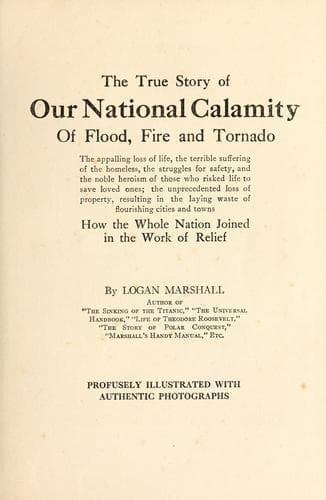
The True Story of Our National Calamity of Flood, Fire and TornadoMarshall, Logan
History
The True Story of Our National Calamity of Flood, Fire and Tornado
Marshall, Logan
Floods -- Ohio River Valley; Omaha (Neb.) -- Tornado, 1913
Many of the refugees were in state institutions on the high ground at
the west end. The water fell several feet and some of the streets
inundated could be traversed, but in the lowlands, where it was feared
the greater number of dead would be found, it was several days before a
thorough search could be instituted.
Many of the refugees were in a pitiable condition when rescued. They
were benumbed by the cold and suffering from hunger and exposure.
FOUR BORN AS OTHERS DIE
Colonel D. N. Oyser, an attache of the city sanitary department,
reported that two truckloads of bodies were removed from one point on
the west side.
The cold wave which struck the section Wednesday night caused many to
freeze, lose their grip, and drop into the water.
[Illustration: Copyright by Underwood & Underwood, N. Y.
Part of the residential section of Fremont, Ohio, flooded. The water
reached to the second story of the houses]
[Illustration: Copyright by George Grantham Bain.
Carrying on the work of rescuing Dayton flood sufferers from their
houses in the boats made for the purpose at the National Cash Register
Factory]
With military glasses rescuers standing on the Baltimore and Ohio
Railroad near Center Avenue could see several dead forms lying on the
roof of a building to the east.
Four babies were reported to have been born in a school house on the
hilltop.
According to those who invaded the stricken district, the churches, big
state institutions and storerooms in the hilltop section were crowded
with refugees. They tell stories of indescribable horrors.
Former Mayor George S. Marshall, who was in telephone communication with
Cecil Randall, his law partner, said that Mr. Randall estimated the
death toll at several hundreds. Throngs of excited groups of people from
the flood-stricken section of the city who were crowded into the
temporary rescue quarters asserted that the estimate of Mr. Randall was
not exaggerated.
Neither the extent of the awful tragedies enacted during the sweeping
away of homes nor the exact death tolls could be known for days until
the mass of wreckage, houses and uprooted trees which were strewn on the
level lowlands south of the city were uncovered. This mass of debris was
under several feet of water, with swift currents running in many
directions.
Many of those rescued told of escaping from their homes by fractions of
minutes, just before the rushing waters swept their homes away and
crushed them like eggshells against bridges. Scores of entire families,
these people assert, were swept down with their houses in the swift
current.
Every available inch of space in the Columbus State Hospital for the
Insane and Mt. Carmel Hospital on the hilltop was occupied by refugees.
Public-domain text, read in full here on John Shaqi.
Reviews
Reviews
No reviews yet
Be the first to share your thoughts on this work.
Elsewhere in the archive
Join the Discussion
Join the discussion
Sign in to leave a comment or review.
Sign InorCreate an account