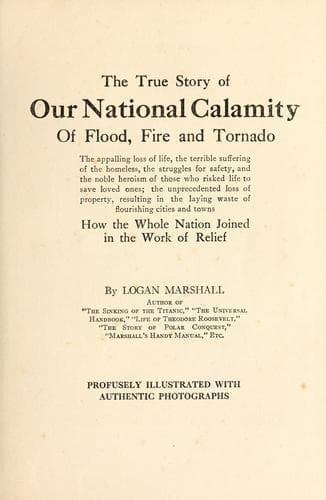
The True Story of Our National Calamity of Flood, Fire and TornadoMarshall, Logan
History
The True Story of Our National Calamity of Flood, Fire and Tornado
Marshall, Logan
Floods -- Ohio River Valley; Omaha (Neb.) -- Tornado, 1913
Governor Cox recalled some of his former comments on the need of
expenditures for the National Guard. "The National Guard," he said, "has
saved itself. Its efficiency has been a revelation to me." In the
organization so promptly effected by the Governor the moment the floods
came, his most efficient aid came from Adjutant-General Speaks and the
National Guard officers, and with the Guard the work of rescue and of
maintaining order was made possible. The officers and men performed
every duty faithfully.
Martial law prevailed in most of the stricken cities and the soldiers
prevented the looting of the abandoned houses and cared for the
refugees.
Colonel Wilson, of the Paymaster's Department, was made financial
officer as well as treasurer of the relief funds. Under his direction
and the Governor's supervision the Ohio relief commission prepared for a
War Department audit, as is required by the Red Cross Society. The
Governor demanded that there should be but one relief committee in the
state, and to that end the local committees formed were subordinate to
the state commission.
INCIDENTS OF HEROISM
The work of rescue brought out many striking incidents of personal
heroism.
From two o'clock Tuesday afternoon until nearly nightfall Wednesday
Charles W. Underwood, a carpenter of this city, held two babes in his
arms while he clung to the branch of a tree near the Greenlawn Cemetery,
where he had been carried fully a mile by the current. One babe was his
own, the other belonged to a neighbor, and as he clung to them he saw
his own twelve-year-old daughter on another limb of the same tree weaken
from exposure and die, her frail body swaying limply as it hung over the
branch. He also saw a woman refugee in the same tree weaken and fall
into the swirling waters. Underwood and the babes were finally rescued.
Two hundred and thirty-three souls marooned in the building of the Sun
Manufacturing Company succeeded in sending out a note by messenger,
praising the work of John Brady, who, with a skiff, after his home was
swept away, rescued two hundred men, women and children and brought them
to the Sun plant.
"Track out at Columbus because of floods," was the message that Albert
E. Dutoit, a Hocking Valley Railway engineer, read when his train was
stopped Wednesday at Walbridge, near Toledo. His heart gave a bound,
for he knew his family must be threatened. He detached his engine from
the train and started on his race with death. Like mad he shot his
engine across the country between there and Columbus. All night
Wednesday he tried to get through the military lines and succeeded on
Thursday. He induced men in motor boats to rescue his family. In a few
more moments, he had his eight-months-old baby in one arm with the other
around the waist of his wife. The reunion brought tears of sympathy to
the eyes of the rescuers.
Public-domain text, read in full here on John Shaqi.
Reviews
Reviews
No reviews yet
Be the first to share your thoughts on this work.
Elsewhere in the archive
Join the Discussion
Join the discussion
Sign in to leave a comment or review.
Sign InorCreate an account