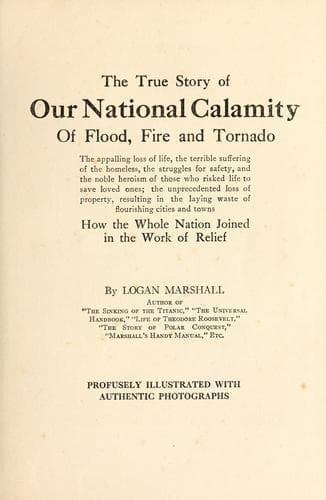
The True Story of Our National Calamity of Flood, Fire and TornadoMarshall, Logan
History
The True Story of Our National Calamity of Flood, Fire and Tornado
Marshall, Logan
Floods -- Ohio River Valley; Omaha (Neb.) -- Tornado, 1913
Mrs. Emil Wallace, living southwest of the city, in the lowlands, ran
toward a hill when she saw the onrushing waters. She reached safety just
as the water was up to her neck. Her home was submerged.
A street car was washed a quarter of a mile away from the track. The
conductor and half a dozen passengers were drowned like rats in a trap
before they could get out of the car.
Two unknown men lost their lives while trying to save a twelve-year-old
girl from a raft floating near Greenlawn Avenue. On horseback the men
fought desperately against the swift current of the flood until at last
they were carried away.
Nearly one hundred babies were born in the flood district and in the
refuge camps between Tuesday morning and Saturday. In the majority of
cases neither the mothers nor the babies received any medical attention.
Many of the babies died from exposure.
As the sun broke through a fringe of clouds Saturday morning it looked
down upon scenes of utter devastation in the stricken west side of this
city, where a mighty torrent of water had rendered what was a prosperous
and happy community of 40,000 souls into a place of death, want and
disaster.
SCENES OF PATHOS
The scenes were full of human pathos. Torn bodies, disfigured almost
beyond recognition, were being dug from debris. Whole families, marooned
for four long days and nights in the upper stories of houses that had
escaped as if by miracle, many of them without food or water and in fear
of constant death by flood or flame, were being reached by rescuers.
Many of those rescued were in a critical condition from the long hours
they had spent in the bitter cold--their clothing soaked by the
incessant rainfall of three days and nights and no fuel or bedding with
which to combat their fearful condition. The water was subsiding
materially and the work of rescue was thus made easier.
The work of the searching parties in the flooded district increased the
list of bodies recovered from the water to sixty-one. All of these were
lodged in the temporary morgue, and most of them were identified.
Accurate estimates of the dead were still impossible. Safety Director
Bargar said not more than one hundred had been drowned. Coroner Benkert
asserted that the loss of life would reach 200, while former Mayor
Marshall, commanding the rescue workers in the southern end of the
flooded district held that both estimates were too high.
Of the sixty-one bodies recovered twenty-seven had been identified.
Estimates placed property loss at from $15,000,000 to $30,000,000. But
no one seemed to care about the monetary loss. The city was staggered by
the weight of human suffering.
Public-domain text, read in full here on John Shaqi.
Reviews
Reviews
No reviews yet
Be the first to share your thoughts on this work.
Elsewhere in the archive
Join the Discussion
Join the discussion
Sign in to leave a comment or review.
Sign InorCreate an account