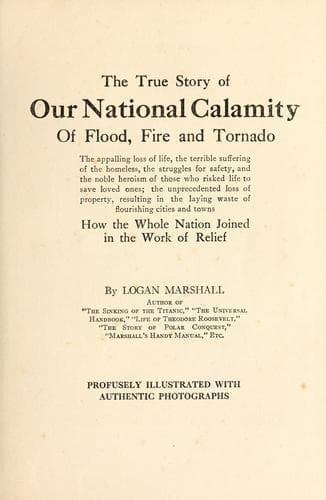
The True Story of Our National Calamity of Flood, Fire and TornadoMarshall, Logan
History
The True Story of Our National Calamity of Flood, Fire and Tornado
Marshall, Logan
Floods -- Ohio River Valley; Omaha (Neb.) -- Tornado, 1913
Governor Cox received a telegram from D. T. McCabe, vice-president of
the Pennsylvania Lines, offering to transport free of charge all relief
supplies to points in the flooded area of the state if properly
consigned to the relief authorities. The Governor also received a
telegram from Governor Ralston, of Indiana, saying that ten carloads of
supplies had been started for Ohio points by Indiana relief
organizations.
Approximately one thousand persons, refugees from the Dayton flood,
arrived in Columbus on Saturday, most of them having made their way by
automobile and trains. As if pursued by tragedy, it fell to them that
their landing place in this city should be within the radius of the
recently-flooded hilltop district of the west side. The arrival of the
refugees was unexpected and no arrangements had been made to care for
them. Adjutant-General John C. Speaks was notified and said that the
state would do the best that could be done to provide them with food and
shelter. General Speaks said that the local relief committees were being
sorely taxed, but that he had been advised by the Columbus relief
committees that they would give all possible assistance in housing and
feeding the Dayton arrivals.
Scores of transfer wagons traversed the inundated streets carrying
relief to the hundreds marooned in the upper stories of houses. An
element adding to the difficulty of the situation was the refusal of
hundreds to leave their homes in the submerged district. This despite
the fact that they were compelled to live in damp upper stories, with
little heat or cooking facilities and in the face of threatened illness.
"We've saved our bedding and furniture, and that's all we have," said
one of these. "We are not going to take any chances of losing that."
City Health Officer Dr. Louis Kahn ordered an immediate cleaning up. The
health authorities also called attention to the necessity of boiling all
water for drinking purposes.
Miss Mabel Boardman, head of the Red Cross Society, reached Cincinnati
Saturday night. She came to confer with Governor Cox. The Governor again
asserted that the property damage caused by the floods in Ohio would
aggregate $300,000,000, and that this amount would be increased by the
high water in the Ohio River.
With the water fast receding in Columbus and the danger stage passed,
the food problem promised on Sunday to become the most serious for the
relief workers to solve.
Mayor Hunt, of Cincinnati, had been sending food to Dayton and other
places, but on Saturday as the flood descended upon his own city from
the upper reaches of the Ohio River, he put an embargo on further
exports of provisions. Though fifty-five carloads of provisions
consigned to the state were in Columbus last night, and supply trains
were headed for Ohio from Chicago, Washington, New York and other
places, Governor Cox was by no means reassured that the relief in sight
would be sufficient.
Public-domain text, read in full here on John Shaqi.
Reviews
Reviews
No reviews yet
Be the first to share your thoughts on this work.
Elsewhere in the archive
Join the Discussion
Join the discussion
Sign in to leave a comment or review.
Sign InorCreate an account