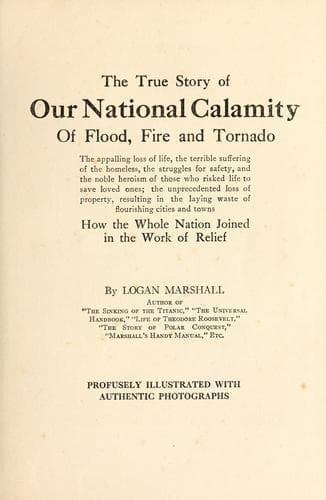
The True Story of Our National Calamity of Flood, Fire and TornadoMarshall, Logan
History
The True Story of Our National Calamity of Flood, Fire and Tornado
Marshall, Logan
Floods -- Ohio River Valley; Omaha (Neb.) -- Tornado, 1913
The church buildings of Columbus include those of the following
religious denominations: Methodist Episcopal, United Presbyterian, Roman
Catholic, Lutheran, Baptist, Disciples, Friends, Christian Scientist,
Evangelical, Jewish, Independent German Protestant, German Evangelical
Protestant, African Methodist Episcopal, Seventh Day Adventists and
United Brethren. The newspapers and periodicals include English and
German dailies, secular weeklies, and trade, professional, religious,
fraternal and other publications. There are numerous public school
buildings, four being devoted to high-school purposes. Among
institutions for higher education are the Ohio State University, Capital
City University and the Evangelical Theological Seminary. Professional
schools include one dental and three medical colleges, and a law school;
and there are also private and religious educational institutions.
Columbus is the location of a state hospital for the insane; state
institutes for the education of deaf mutes, blind and imbecile youth;
the Ohio penitentiary; county, city and memorial buildings; five opera
houses; and a board of trade building. There are five public parks and a
United States military post, Fort Columbus. This post, known also as
Columbus Barracks, was originally an arsenal, and now has quarters for
eight companies of infantry.
From Columbus steam railroads radiate to all parts of the state,
intersecting all through lines running east, west, northwest, northeast
and south; and interurban lines connect with a model street-railway
system.
TRADE AND INDUSTRIES
Columbus is near the Ohio coal and iron fields, and has an extensive
trade in coal, but its largest industrial interests are in manufactures,
among which the more important are foundry and machine products, boots
and shoes, patent medicines, carriages and wagons, malt liquors,
oleomargarine, iron and steel, and steam railway cars. There are several
large quarries adjacent to the city.
CHARACTERISTICS OF ITS RESIDENTS
The citizens of Columbus possess the characteristic push and enterprise
of western people, and much of the culture and artistic taste of those
in the east. The population is drawn chiefly from the counties in the
state, and especially from those which are centrally located. The
largest foreign elements are German, Irish, Welsh, English and Italian,
and include scattered groups and individuals from almost every civilized
and semi-civilized country in the world.
CHAPTER IX
CINCINNATI: A NEW CENTER OF PERIL
A GREAT MANUFACTURING CITY--THE TUESDAY CLOUDBURST--ANXIOUS
WAITING--HOMES SUBMERGED--FACTORIES FORCED TO CLOSE--THE SITUATION
EVER GRAVER--EXPLOSIONS IN THE CITY--THE CRISIS--FLOOD DAMAGE.
Public-domain text, read in full here on John Shaqi.
Reviews
Reviews
No reviews yet
Be the first to share your thoughts on this work.
Elsewhere in the archive
Join the Discussion
Join the discussion
Sign in to leave a comment or review.
Sign InorCreate an account