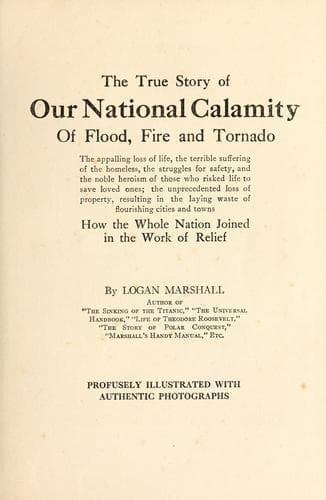
The True Story of Our National Calamity of Flood, Fire and TornadoMarshall, Logan
History
The True Story of Our National Calamity of Flood, Fire and Tornado
Marshall, Logan
Floods -- Ohio River Valley; Omaha (Neb.) -- Tornado, 1913
Scarcely had Dayton, Columbus and Zanesville begun their real battle for
restoration when Cincinnati became a new peril center. Situated on the
Ohio River at the point where the Muskingum, Scioto, the two Miamis, and
the Licking were pouring their millions of gallons of flood water into
the river, the city was bound to suffer. It seemed as if the Buckeye
State would never be able to escape from the clutches of the great demon
of flood.
A GREAT MANUFACTURING CITY
Cincinnati is the county seat of Hamilton County, in the extreme
southwest of the state, one of the great commercial and manufacturing
centers of the Union, tenth in nominal rank, and seventh or eighth in
fact. It is situated on the north bank of the Ohio River, almost exactly
half way from its origin at Pittsburgh to its mouth at Cairo, Illinois.
On the western side of the city from west to south runs Mill Creek, the
remains of a once glacial stream, whose gently sloping valley, half a
mile or more wide, forms an easy path into the heart of the city, and
was an indispensable factor in determining its position. Highways,
canals and railroads come through it, and the city's growth has pushed
much farther up this valley than in other directions. The railroad
stockyards are on its eastern slope. Cincinnati extends for about
fourteen miles along the river front, to a width of about five in an
irregular block north from it, but attains a width of six or seven miles
at the extreme point along the creek valley.
The bottom level below the bluffs along the riverside is the seat of the
river shipping business, and has as well the usual fringe of low
quarters; it is paved, and there is a broad public landing fronted by
floating docks, wharf-boats, etc. Above are the wholesale and then the
retail business streets, with great extent and variety of fine business
architecture, and gridironed with electric roads. The principal lines
converge at or near Fountain Square, and connect with a ring of
beautiful suburbs, within and without the city limits, unsurpassed in
America.
Among the sights of interest is the busy public landing or levee. The
Grand Central Depot, a terminal of several of the largest roads, is
centrally situated near the river. Among the most prominent buildings
are that of the United States Government Custom House, the City Hall,
the City Hospital, the Springer Music Hall, the Odd Fellows and Masonic
Temples, the Public Library, with 431,875 volumes, and the Museum of
Natural History. St. Peter's Cathedral, St. Paul's Protestant Episcopal
Cathedral, St. Paul's Methodist Episcopal Church, the First and Second
Presbyterian Churches, and the Jewish Synagogue are handsome edifices.
Fine hotels and theaters are numerous. The biennial musical festivals
are famous.
THE TUESDAY CLOUDBURST
Public-domain text, read in full here on John Shaqi.
Reviews
Reviews
No reviews yet
Be the first to share your thoughts on this work.
Elsewhere in the archive
Join the Discussion
Join the discussion
Sign in to leave a comment or review.
Sign InorCreate an account