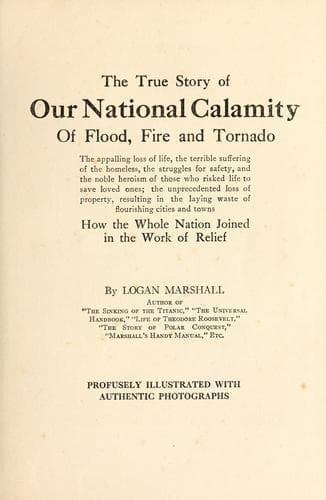
The True Story of Our National Calamity of Flood, Fire and TornadoMarshall, Logan
History
The True Story of Our National Calamity of Flood, Fire and Tornado
Marshall, Logan
Floods -- Ohio River Valley; Omaha (Neb.) -- Tornado, 1913
"Every stream we crossed seemed to be a raging torrent, its waters
racing at top speed," said one traveler who arrived in Chicago on March
26th. "We could hear the swish of the waters and hear the cries of
people in distress," reported another.
Yet these eye-witnesses could not see the worst of the four vast floods
that swept over the state of Indiana, tying up the railroads, rendering
thousands of persons homeless, killing scores of others, wiping out
whole towns. Just how many persons lost their lives in the great floods
will probably never be known.
THE FOUR FLOODS
Indiana had known many devastating floods, but none like to this in
either destructive force or extent. On March 26th three distinct flood
districts prevailed--the eastern part of the state including the valley
of the White Water River and the Fort Wayne territory, the valley of the
White River and its tributaries, and the valley of the Wabash. Later
the flooding of the Ohio River and its tributaries added to the awful
tale of disaster. The entire state was practically one huge sea, and
every brook, creek and river exacted its toll of damage.
The overflow, coming with astonishing suddenness, caught farmers
throughout the state unprepared and the breaking of levees in many
places forced persons living along the rivers to desert their homes. In
the crowded cities it added woe upon woe.
The appalling swiftness with which the waters rose found city as well as
state unprepared. Streams that were brooks Easter morning had become
raging torrents on Tuesday. Persons who retired in apparently safe homes
Monday were rescued the following day from second-story windows with
boats. Lowlands became vast lakes.
The dawn of Wednesday, March 26th, found anxiety in Indiana centered in
Brookville and Connersville, on the White Water River, from which
frantic appeals for aid were received by Governor Ralston.
Other despatches from the same region declared that the smaller towns of
Metamora, Cedar Grove and Prenton were swept away completely.
DISASTER IN BROOKVILLE
Sixteen persons were drowned at Brookville, when they were caught by the
east and west forks of White Water River which meet in that town.
Survivors told of attempts of men, women and children to escape by the
light of lanterns. Cross currents rushing along streets and alleys
carried them down to a united stream a mile wide just south of the town.
Five children, all of one family, were seen clinging to posts of an
old-fashioned wooden bed when they were swept into the main stream and
lost.
The person from Connersville who first talked with the Governor said
that a break in the White Water River levee had flooded the valley,
sweeping many persons before it. After that it was impossible to
re-establish communication even for a few minutes. Militia were ready
all during the night to hurry to the town, but no train was operated in
that direction.
PEOPLE GATHERED IN CHURCHES
Public-domain text, read in full here on John Shaqi.
Reviews
Reviews
No reviews yet
Be the first to share your thoughts on this work.
Elsewhere in the archive
Join the Discussion
Join the discussion
Sign in to leave a comment or review.
Sign InorCreate an account