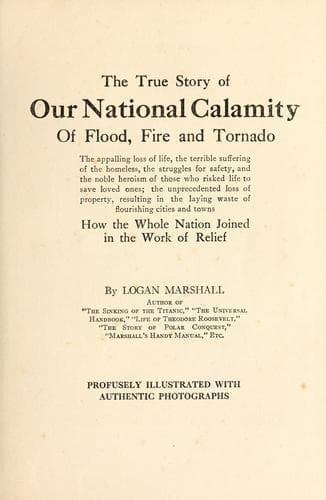
The True Story of Our National Calamity of Flood, Fire and TornadoMarshall, Logan
History
The True Story of Our National Calamity of Flood, Fire and Tornado
Marshall, Logan
Floods -- Ohio River Valley; Omaha (Neb.) -- Tornado, 1913
Five wagon bridges, the Big Four Railroad bridge, the depot and a paper
mill were utterly destroyed. Fifty summer houses on White Water River
south of Brookville were washed away, foundations and all. People, bowed
down by the calamity, gathered in churches, where religious services
were held. None of the bodies were recovered for several days.
Hall Schuster was drowned Thursday night in an attempt to cross the West
Fork of the White River at Brookville to rescue Harlan Kennedy, a
hermit, formerly a Methodist minister.
Two hundred and fifty children rescued from the flood had only night
clothes. Wagon trains carried food and clothing from Connersville to the
stricken people.
On Friday, March 28th, the list of known dead in Brookville was
sixteen. Heavy loss of property and a food and fuel famine imminent were
the precise situation.
There were six persons missing, and it was feared that they had been
drowned and their bodies washed away or buried in debris that had not
yet been searched.
Brookville was practically under martial law, and twenty men were driven
out of the city after they were discovered looting damaged homes and
buildings.
NEWS FROM LAUREL
News from Laurel reached Connersville on Saturday when Deputy Postmaster
George Lockwood came through on horseback. He said the White Water River
valley, eleven miles around Laurel, was flooded, and the damage
estimated at $300,000.
Four buildings and many small houses were wrecked in Laurel, but no
lives were lost. Several farmers in the valley between Brookville and
Laurel were missing and their houses had disappeared. Several other
towns in the valley were inundated and many houses had been swept away.
SURGING FLOOD AT FORT WAYNE
At Fort Wayne, in the northeastern part of the state at the confluence
of the St. Mary's and the Maumee Rivers, the flood surged for three
days.
A keeper in the Orphan Asylum and five men in a surfboat did splendid
work in saving seventy-five inmates of the asylum from drowning. All
life-saving stations in the flooded district devoted their utmost
efforts to the work of rescue and used their funds and supplies without
stint. The relief work was in every way well organized.
SITUATION UNDER CONTROL
On March 28th, with the flood receding at the rate of three inches an
hour, Fort Wayne had the situation in control and stood ready to assist
its less fortunate neighbors. Many of the refugees were able to get back
into their homes. The property loss was estimated at $4,000,000, and it
was almost certain that the loss of life would not exceed six.
The pumping station had been started up the previous night, two
locomotives sent by the Lake Shore Railroad furnishing the power. The
water was being pumped from the river. The only drinking water available
for several days was brought in bottles.
CHAPTER XIV
THE DESOLATION OF INDIANAPOLIS AND THE VALLEY OF THE WHITE RIVER
Public-domain text, read in full here on John Shaqi.
Reviews
Reviews
No reviews yet
Be the first to share your thoughts on this work.
Elsewhere in the archive
Join the Discussion
Join the discussion
Sign in to leave a comment or review.
Sign InorCreate an account