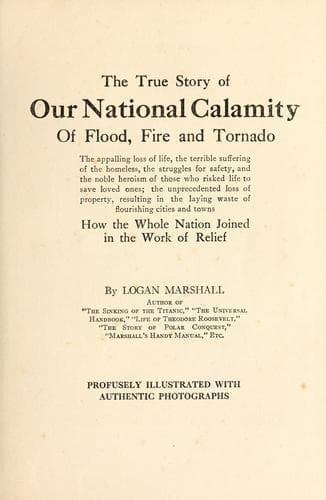
The True Story of Our National Calamity of Flood, Fire and TornadoMarshall, Logan
History
The True Story of Our National Calamity of Flood, Fire and Tornado
Marshall, Logan
Floods -- Ohio River Valley; Omaha (Neb.) -- Tornado, 1913
THE TWO FORKS OF THE WHITE RIVER--WORST DAMAGE IN
INDIANAPOLIS--SYSTEMATIC RESCUE WORK--THIEVES BENT ON
PLUNDER--PREDICAMENT OF WEST INDIANAPOLIS--THE RECEDING
WATERS--FLOOD VICTIMS HELPLESS--AN APRIL WEDDING--OTHER TOWNS
AFFECTED.
The two great forks of the White River and their tributaries drain about
half of the area of Indiana. Indianapolis, the capital of the state, is
situated on the West Fork. In this city and more particularly in West
Indianapolis the torrent roaring through the White River valley did its
worst damage.
Hundreds of spectators were watching the river on Tuesday evening, March
25th, when, with a roar that could be heard for blocks, hundreds of tons
of dirt in the Morris Street levee crumbled under the pressure, and
great walls of water rushed through the opening.
Men, women and children fought through the water toward a near-by
bridge, which seemed to offer the only safety. Many houses were torn to
pieces by the rush of the water, and others were carried away. Families
in one-story homes were at the mercy of the sudden rush of water that
followed. The people were literally trapped in their own houses.
OTHER TOWNS AFFECTED
Other towns affected by the flooding of the White River and its
tributaries were Muncie, Elwood, Anderson, Noblesville, Bloomington,
Washington, Newcastle, Rushville, Shelbyville, etc. At Noblesville the
river was the highest it had been in thirty-three years, at Muncie a
dike in the water plant broke and the city was without fire protection.
At Rushville Flat Rock Creek waters rose with a roar, and clanging fire
bells warned the people to flee. The entire business section was
submerged. One person met death in Muncie; one in Newcastle; one in
Rushville, and five in West Indianapolis.
Indianapolis awoke the following morning to find the waters higher than
ever appeared before, with a property loss that two days before would
have been unbelievable. It was hard to bring the full realization of the
damage to the people, who had no thought of a flood from streams that
ordinarily are unimportant, aiding only in beautifying the city's parks
and boulevard driveways.
A NIGHT OF DISASTER AND FEAR
During the night the water advanced upon the exclusive residence section
along Fall Creek. It tore away one bridge, destroyed the city's most
pretentious driveway and forced the families living along its banks to
desert their palatial homes.
A few hours before they had no idea they were in any danger, and were
awakened by the militiamen to be ordered from the threatened buildings,
only to find every hotel in the city full. They were cared for at the
homes of friends.
The Washington Street bridge over the White River that connects
Indianapolis and West Indianapolis, which was closed for traffic late
Tuesday night, in the early morning was torn apart by the waters, the
floor of the structure being carried away.
A DESOLATE CITY
Public-domain text, read in full here on John Shaqi.
Reviews
Reviews
No reviews yet
Be the first to share your thoughts on this work.
Elsewhere in the archive
Join the Discussion
Join the discussion
Sign in to leave a comment or review.
Sign InorCreate an account