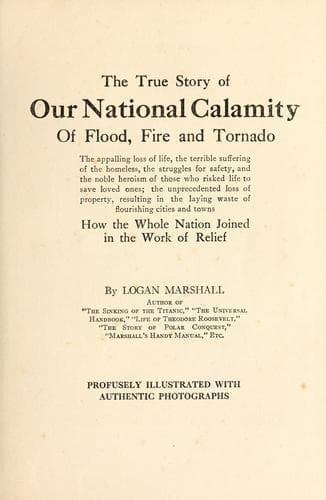
The True Story of Our National Calamity of Flood, Fire and TornadoMarshall, Logan
History
The True Story of Our National Calamity of Flood, Fire and Tornado
Marshall, Logan
Floods -- Ohio River Valley; Omaha (Neb.) -- Tornado, 1913
Thieves took advantage of the wrecking of lighting plants to plunder
deserted houses and even to rob survivors of the flood. In West
Indianapolis the vandals and robbers became so bold that Governor
Ralston placed that section of the city under martial law and sent a
company of militia to guard the streets. Orders were given to shoot on
sight any one caught at robbery.
PREDICAMENT OF WEST INDIANAPOLIS
The greed of provision dealers angered Governor Ralston to such an
extent that he started an investigation. Before the supply of bread
available on the West Side had been exhausted, loaves were selling at
twenty cents each. The supply of meat was entirely exhausted.
That section of Indianapolis lying west of the river, where martial law
was proclaimed, is the poorest in the city. The supply of meats, eggs,
milk, coffee, bread and butter was practically exhausted before noon.
Little except canned goods remained on the shelves of the grocers.
Relief trains loaded with provisions were unable to enter this district.
Members of the board of public safety and other city officials inspected
the entire flooded district from motor boats and directed efficient
organization of the relief workers, aiding the state troops and state
officials in every possible way.
THE RECEDING WATERS
By Friday the White River had begun to fall slowly, and the work of
caring for the suffering could be prosecuted vigorously. It was
estimated that the property loss in the city and environs would reach
$10,000,000. Part of this loss was in destroyed bridges. The Vandalia
Railroad bridge over the White River went down Friday, carrying with it
ten loaded cars.
By Monday, March 31st, White River waters had returned to almost normal
channel, and the areas that were covered were being searched to locate
the bodies of any who might have been drowned. The city board of health
prepared typhoid serum for 50,000 treatments to aid in warding off an
epidemic. State troops were withdrawn.
On Tuesday hundreds of homes were cleaned and, with furniture which
could be salvaged and that supplied by the Relief Committee, the owners
were able to resume housekeeping. Relief funds were still increasing
and all persons who lost homes or furniture in the flood were being
cared for.
Many persons in the West Indianapolis flood district were treated with
an anti-diphtheria vaccine, and Dr. T. V. Keene, in charge of the
medical relief work in the flooded districts, said he feared no
epidemic.
FLOOD VICTIMS HELPLESS
Hundreds of thousands of dollars were reported necessary to relieve
suffering among the flood refugees in Indianapolis, according to the
report of the General Relief Committee, made on Wednesday, April 2d, at
a meeting in Mayor Shank's office.
Plans for raising a vast sum of money, to be made available immediately
to the sufferers, were discussed and it was decided to start popular
subscriptions and designate places for contributions.
Public-domain text, read in full here on John Shaqi.
Reviews
Reviews
No reviews yet
Be the first to share your thoughts on this work.
Elsewhere in the archive
Join the Discussion
Join the discussion
Sign in to leave a comment or review.
Sign InorCreate an account