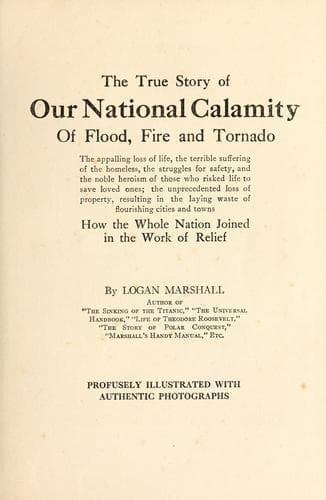
The True Story of Our National Calamity of Flood, Fire and TornadoMarshall, Logan
History
The True Story of Our National Calamity of Flood, Fire and Tornado
Marshall, Logan
Floods -- Ohio River Valley; Omaha (Neb.) -- Tornado, 1913
Joseph C. Schaf, one of the investigators for the committee, said:
"The flood victims are helpless. They need money and need it
immediately. The men are trying to hold their jobs and let the women
clean up the homes, and it is a disheartening task for which many are
not physically able. Give them money immediately so they can pile their
water-soaked mattresses and other furniture in the street and touch a
match to it. That will give them new heart."
Mr. Schaf increased his donation by $1,000, and several other members of
the committee did likewise.
CHAPTER XV
THE ROARING TORRENT OF THE WABASH
A BITTER TALE OF DESTRUCTION--MANY PEOPLE DRIVEN FROM HOMES--ALARMING
CONDITIONS--THE PLIGHT OF KOKOMO--THE HOMELESS IN WABASH--DISTRESS OF
LOGANSPORT--MILITARY CADETS AID IN RELIEF--NEW DISASTER AT
LAFAYETTE--A SECOND HORROR IN TERRE HAUTE--THE RECEDING WATERS.
Bitter was the tale of destruction in the valley of the Wabash River and
its tributaries. A traveler journeying over the Wabash Railroad on
Easter Sunday would have seen only the usual quiet little towns of the
Middle West; three days later, if he could have looked down over the
same territory he would have seen nothing but a raging torrent sweeping
through the region like some fiendish monster devouring and destroying
as it pursued its mad course. He would have found the entire Wabash
Valley, including Logansport, Wabash, Lafayette and Peru, a desolate
scene, its scores of prosperous cities absolutely paralyzed and cut off
from the outer world. Telephone and telegraph wires were down
everywhere; trains were not running and roads were obliterated.
MANY PEOPLE DRIVEN FROM HOMES
As early as Monday, March 24th, northern Indiana had suffered severe
loss, due to the heavy rains of the previous twenty-four hours, which
had carried away bridges, stopped railroad and interurban traffic,
flooded store basements, driven people from their homes along the river
banks, and washed away houses. At Hartford City there were seven feet of
water in the paper mills and the merchants had lost heavily from flooded
basements.
At Portland water was standing three feet deep in the center of the city
and the loss to merchants from damage to goods reached $100,000.
The wind, which followed heavy rain, cut a path several hundred feet
wide.
At Kokomo the light, heat, power, gas and water plants were out of
commission and the river was still rising. The city was without fire
protection; South Kokomo, with 6,000 inhabitants, was cut off from the
main city.
It was declared to be the worst flood known in Wabash since 1883; and
rain was still falling. Hundreds of residents of the lowlands abandoned
their homes. Interurban traffic was paralyzed.
ALARMING CONDITIONS
Public-domain text, read in full here on John Shaqi.
Reviews
Reviews
No reviews yet
Be the first to share your thoughts on this work.
Elsewhere in the archive
Join the Discussion
Join the discussion
Sign in to leave a comment or review.
Sign InorCreate an account