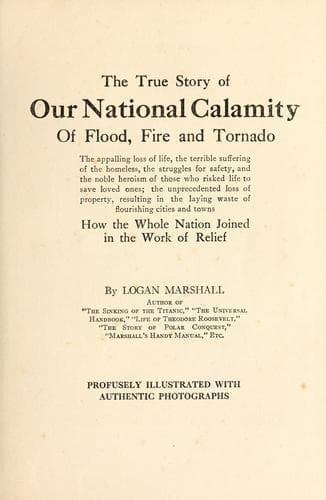
The True Story of Our National Calamity of Flood, Fire and TornadoMarshall, Logan
History
The True Story of Our National Calamity of Flood, Fire and Tornado
Marshall, Logan
Floods -- Ohio River Valley; Omaha (Neb.) -- Tornado, 1913
Of all the cities devastated by flood in Indiana, Peru was the most
desolated. Situated on the Wabash River just below the entrance of the
Mississinewa, it suffered more than any of the stricken cities through
which the angry, swollen waters of the Wabash flowed.
"This probably will be the last message you will get from Peru," said
the man who telegraphed to Governor Ralston on March 25th, asking for
coffins, food and clothing. "Two hundred or more are drowned and the
remainder of the residents are waiting for daylight."
AT ONCE TO THE RESCUE
Governor Ralston immediately communicated with State Senator Fleming at
Fort Wayne and asked him to forward the coffins and other supplies as
requested.
When the messages of distress from Peru were sent forth South Bend and
other cities sprang nobly to the rescue. They found the people half
crazed from exposure, want and fear. One of the rescue party who made
the trip in the first boat that entered the city said:
"The cry to be saved from those who saw the first boat was heartrending.
Some of them threatened to jump into the water if we did not take them
aboard. But it was impossible with the scant boat supply to take all
away at once."
THOUSANDS MAROONED
Relief parties from South Bend were the first to arrive on the scene.
They found hundreds of people huddled together in the court house
square, which was three miles from the nearest dry land; hundreds more
were marooned in the upper stories of buildings already rendered unsafe
by the high water. There was no heat, no light, no water, and sanitary
conditions were horrible. The only motor boat had broken and it was too
dangerous to venture into the raging torrent in rowboats. This made it
impossible for the South Bend relief volunteers to get blankets and food
to the sufferers.
TALES OF STRUGGLE
Death faced hundreds of persons who were clinging to the roofs of
buildings, where they sought refuge. Currents of muddy water from ten to
twenty-five feet deep were running through the main streets at twenty
miles an hour.
Harry Lumley, a despatcher, lay on a table all Wednesday in the Peru
station of the Lake Erie and Western Railroad, which the water had
invaded, and kept open the line for relief trains.
Dr. W. A. Huff, a dentist, started to South Peru with an unknown man
Tuesday night. The boat capsized and Huff lodged in a tree, where he
remained until Wednesday morning. His condition was critical.
No effort was made to count the dead. "Our energies are being devoted
entirely to saving those still living," said Lieutenant-Governor
O'Neill. "It is impossible for us even to try to learn the whereabouts
of the bodies just now."
A VIGILANCE COMMITTEE
Citizens, finding lawlessness in every block of the city above water,
organized a vigilance committee with orders to shoot looters.
Public-domain text, read in full here on John Shaqi.
Reviews
Reviews
No reviews yet
Be the first to share your thoughts on this work.
Elsewhere in the archive
Join the Discussion
Join the discussion
Sign in to leave a comment or review.
Sign InorCreate an account