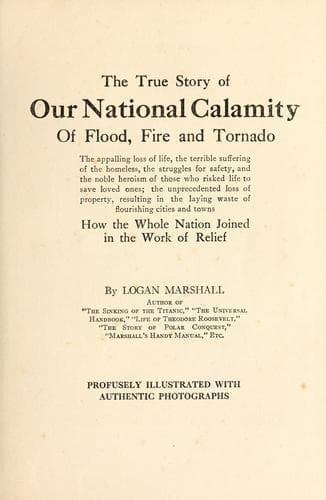
The True Story of Our National Calamity of Flood, Fire and TornadoMarshall, Logan
History
The True Story of Our National Calamity of Flood, Fire and Tornado
Marshall, Logan
Floods -- Ohio River Valley; Omaha (Neb.) -- Tornado, 1913
By indirect telephone routes on Thursday, Governor Ralston received an
urgent call from Logansport for troops to aid in rescue work and to
patrol the city. The city had been cut off from reliable communication
with the outside world since Tuesday evening. The continuance of the
high waters added hourly to the heavy property losses, and the snowstorm
and bitter cold caused intense suffering.
NEW DISASTER AT LAFAYETTE
At 2 P. M. on Tuesday, March 25th, two spans of the bridge over the
Wabash River at Lafayette went out, carrying a number of people with it.
Boats below the bridge succeeded in rescuing all but one man.
At 3.15 P. M. West Lafayette, where Purdue University is located, was
cut off from Lafayette by the breaking of one of the levees and the
submerging of the other. The river was two miles wide and business
houses were preparing to move their wares, anticipating a three-foot
rise during the night. No interurban lines were being operated and steam
lines were making little effort to maintain train service.
The business district and the south and west sides of Logansport were
under water. The bridge at the Country Club had been washed away.
A SECOND HORROR IN TERRA HAUTE
All down the length of the Wabash the torrent raged. Hardly recovering
from the daze of the Easter tornado, treated in another chapter, Terra
Haute inside of forty-eight hours faced its second disaster, when the
waters of the Wabash left the banks, flooding part of the residence
section.
The river was then rising at the rate of five inches an hour. Railroad
traffic was suspended and interurban traction service had been
abandoned. Residents of Taylorville, Robertsville and West Terre Haute
deserted their homes, fleeing before the approaching waters. Five
hundred homes were under water and the coal mines near the city were
flooded.
For two days the situation seemed to grow hourly more desperate. On
Thursday the river had reached a stage of thirty-one feet six inches and
was steadily rising. Four thousand persons were homeless, and those
whose homes were on higher ground were without gas or electricity.
Traffic was at a standstill.
THE RECEDING WATERS
But slowly the waters receded and the work of reconstruction was begun.
On down the river the disaster-bringing torrent traveled. Throughout all
southern Indiana the river reached unprecedented stages and hundreds
were driven from their homes. Railroad lines were covered with water
through many counties, and on March 31st the river was reported forty
miles wide between Upton, Indiana, and Carmi, Illinois.
CHAPTER XVI
THE PLIGHT OF PERU: A STRICKEN CITY
LAST MESSAGE FROM PERU--AT ONCE TO THE RESCUE--THOUSANDS
MAROONED--TALES OF STRUGGLE--FAMINE AND DISEASE--GREED ABROAD IN
THE CITY--REFUGEES URGED TO LEAVE--SEARCH FOR THE DEAD--SHAKING OFF
DESPAIR.
Public-domain text, read in full here on John Shaqi.
Reviews
Reviews
No reviews yet
Be the first to share your thoughts on this work.
Elsewhere in the archive
Join the Discussion
Join the discussion
Sign in to leave a comment or review.
Sign InorCreate an account