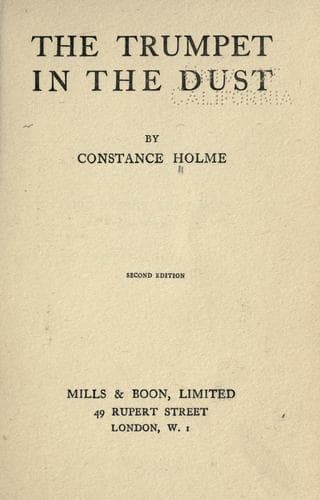
Almshouses -- Fiction; Older women -- Fiction; Villages -- England -- Fiction; Women cleaning personnel -- Fiction
“I’m off to have a look at t’ house,” she added, by way of making a
second apology for the black gown. “Likely it seems a bit soon to go
rushing up, but folks should make the most o’ their time when they’re
not as young as they was!”
“That’s so. Not but what you’ll have many a happy year there, I don’t
doubt!” Mrs. James finally capped the conversation, and remained at
the door watching her as she swam away. Everybody seemed to stand
and watch her to-day, Mrs. Clapham thought, self-conscious in every
limb as she climbed guiltily towards Emma’s. She felt guilty because,
side by side with her reluctance about the visit was a half-formed
curiosity as to what Emma could have to say. It was because of this
latent curiosity in herself that she had not mentioned the invitation
to Mrs. James. It made her uneasy in some inexplicable way, just as
the strange little scene which had just passed had made her uneasy.
It was as if something within her warned her of some approaching
event, in which she and Emma, neighbours for years and yet almost
complete strangers, should be brought sharply together and carry the
principal parts....
She went up the steps slowly, and with a distinctly ashamed air,
feeling the eyes of the Chorus glued to her turned back, not knowing
that Providence had already seen to it that they should be otherwise
engaged. Mrs. Airey and Mrs. Dunn were at that moment holding anxious
converse over a scorched frill; Mrs. James was recalled indoors
at the critical point by a bump as of something violently fallen
upstairs; while Mrs. Tanner, although drawn to the window by some
psychological pull, was hurled back again, as it were, by the awful
spectacle of the cat on the shelf with the beef....
CHAPTER IV
The whole world had seemed bright with the fine September day which
had been sent to bless Mrs. Clapham, but there was no September
day in Emma Catterall’s. Most houses take on a different character
with the seasons, and are either cosy or dreary in winter, sunny or
stuffy in summer; in spring, perhaps, full of unexpected light and
shade, and in autumn of the after-glow of sunsets or the splendour of
windows framing some golden tree. But in Emma Catterall’s house the
year went by without ever setting foot inside her door, never once
renewing the atmosphere or cleansing it by a breath. Going into it
was like going into some primitive cave, where all that the centuries
seemed to do for it was to make it ever more dark and damp, and to
add to the whispering bats that clung about its walls.
Public-domain text, read in full here on John Shaqi.
Reviews
Reviews
No reviews yet
Be the first to share your thoughts on this work.
Elsewhere in the archive
Join the Discussion
Join the discussion
Sign in to leave a comment or review.
Sign InorCreate an account