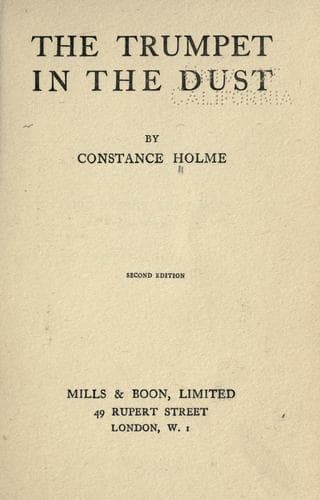
Almshouses -- Fiction; Older women -- Fiction; Villages -- England -- Fiction; Women cleaning personnel -- Fiction
Yes, it must be Miss Marigold’s wedding that was making her think
of the absent Tibbie, thinking so vividly that instead of absent
she was very much present. In the little room where the sun kept
pushing its way she seemed almost there in the flesh, catching and
reflecting the light with her shimmering scissors and silks. The
children, too, seemed unaccountably near, so that she felt as if
at any moment she might hear their gentle if chattering voices and
their sober if pattering feet. Their post-card photographs were
on the shelf with that of their mother, seven-year-old Libby and
five-year-old Stevie—stiff, grave, patient little people, who looked
as if they couldn’t possibly belong to laughing Tibbie. Those who
noticed the difference said that they looked as though they had been
born protesting against the sorrows of a great war, but those who had
known their father and their father’s mother said something else. It
was from Stephen Catterall that they inherited their pale, haunted
faces and their mournful dark eyes. When Stephen was killed, they
said in Whalley that he had always looked as though the hand of death
was never far from his tragic face, but those who had known him as
a child knew it was never a little thing like death that had made
Stephen afraid....
Mrs. Clapham had once been to Whalley to pay her daughter a visit,
and once Tibbie and the children had come to Mrs. Clapham, but
on neither side had the visit been repeated. One had her charing
to think of, and the other her sewing, and both had their other
supremely important reasons.... But the result of the separation was
that Mrs. Clapham knew very little about Tibbie’s children, except
what she was able to learn from Tibbie’s letters. She was fond of
them as far as she did know them, and of course proud, but she was
always a little puzzled about them, a little uneasy. They were so
very unlike what Tibbie had been, or Tibbie’s uncles and aunts; so
very unlike what Mrs. Clapham had been herself. But there was no
reason to worry about them or their mother, as she knew, seeing
that they were comfortably off, and had plenty of neighbours and
friends. If it had not been for that she could never have felt this
satisfaction in the change which, other individuals being willing,
she was shortly proposing to take. She would have been afraid that,
as soon as the home was broken up, Tibbie and Co. might possibly want
to come back. But there was no chance of such a thing as long as
certain circumstances existed; Tibbie would never come. She fretted
for her mother sometimes, just as her mother fretted for her, but as
long as a certain person remained alive, Tibbie would never come.
Public-domain text, read in full here on John Shaqi.
Reviews
Reviews
No reviews yet
Be the first to share your thoughts on this work.
Join the Discussion
Join the discussion
Sign in to leave a comment or review.
Sign InorCreate an account