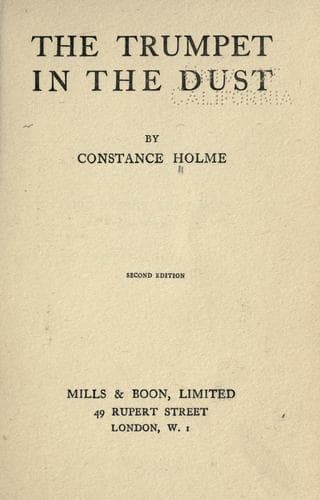
Almshouses -- Fiction; Older women -- Fiction; Villages -- England -- Fiction; Women cleaning personnel -- Fiction
It was like old Mr. T. to have seen to it that the kitchen had a
wooden floor, and an elegant block floor of the best pitch-pine at
that. He knew how warm and easy it would be to aging feet, how smart
to the eye, and how simple to keep clean. It was like him, too, to
have ordered thick curtains for the window facing the sea, knowing
what draughts would come sweeping in when the gales were at their
height. But no matter where she turned she found continual witness to
his careful thought. There were a hundred practical details in which
she recognised his mind—the mind of the Lancashire business-man who
did well whatever he touched.
It was like the other side of him, too, Mrs. Clapham thought, peeping
at last into the parlour, to have provided a room like this for the
tenant’s pride. There were people who said that poor folks didn’t
need a parlour, but of course they couldn’t have understood what
it really meant. Old Mr. T., however, had understood, although you
couldn’t have driven him into his own beautiful drawing-room even
with whips. He knew that a parlour was a kind of private church,
where you locked up the things that were precious to you, and went
away happy because they were safe. So he had always insisted upon a
parlour in each of his houses, though he took care to make it the
right size; not too big so that it would mean worry and work, and yet
more than sufficiently big to hold treasures and dreams.
With an almost hushed step she went open-eyed round the room, laying
a light finger upon tables and chairs, and stooping reverently to
feel the pile of the carpet. There were ornaments and lace curtains,
pictures, a “best” tea-set in the cupboard; but she did not dwell on
them for very long. The parlour would need hours of worship all to
itself, and she could not possibly spare them now. Coming out, she
found a last touch of the “parlour” side of old Mr. T. in the white
china handle and finger-plate of the parlour door. She had a really
helpful cry out when she noticed these, sobbing contentedly against
the wall.
Curiosity, however, soon got the uppermost of emotion, and presently,
feeling very much better, she set off upstairs. The stair-carpet was
not down, she was glad to see, for the third time that day feeling
her hands itching for brush and pail. The stairs themselves were just
the right width and depth for shaky old feet, and there were knobs
on the rail to which, on occasion, feeble old hands might cling. A
window at the turn prevented the staircase from being dark, and at
the same time satisfied a deep-seated human need by allowing a peep
at a neighbour’s affairs. There was an oak press on the landing, and
a grandfather’s clock, and the little brass handles of the doors
shone to greet her like lumps of gold.
Public-domain text, read in full here on John Shaqi.
Reviews
Reviews
No reviews yet
Be the first to share your thoughts on this work.
Elsewhere in the archive
Join the Discussion
Join the discussion
Sign in to leave a comment or review.
Sign InorCreate an account