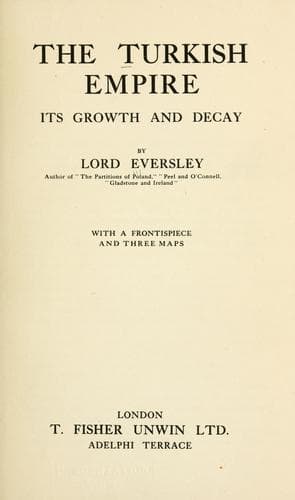
The Turkish Empire, Its Growth and DecayEversley, G. Shaw-Lefevre (George Shaw-Lefevre), Baron
History
The Turkish Empire, Its Growth and Decay
Eversley, G. Shaw-Lefevre (George Shaw-Lefevre), Baron
Turkey -- History
In spite of this crime and of the base murder of his most intimate
friend and servant, Ibrahim, in spite of the inception of the grave
abuses we have referred to, it must be admitted, on an impartial review
of Solyman’s reign, that Solyman was the greatest of the Othman race
who created the Empire, and that in a generation of famous rulers in
Europe, including Charles V, Francis I, Leo X, our own Henry VIII,
Sigismund of Poland, and others, he excelled them all in the deeds and
qualities which constitute the greatness and fame of a ruler. There is
a Turkish proverb to the effect that “Happy is the man whose faults can
be numbered, for then his merits cannot be counted.”
XI
GRAND VIZIER SOKOLLI
1566-78
SOLYMAN was the last and greatest of the first ten Ottoman Sultans
who, succeeding one another from father to son, in rather less than
three hundred years, raised their Empire from nothing to one of the
most extended in the world. They must have been a very virile race, for
their reign averaged about twenty-eight years, far above the ordinary
expectations of life. With one exception they were all able generals
and habitually led their armies in the field. They were all statesmen,
persistent in pursuing their ambitious aims. Many of them were addicted
to literary pursuits, were students of history, and even had reputation
as poets. In spite of these softening influences, there was in nearly
all of them a fund of cruelty. It may be doubted whether, in the
world’s history, any other dynasty has produced so long a succession of
men with such eminent and persistent qualities.
Solyman was succeeded by his third son, Selim, commonly called ‘the
Sot,’ a sobriquet which sufficiently describes him. He was the only
son spared from the bow-string. Selim was followed by twenty-four
other Sultans of the Othman dynasty down to the present time. With the
rarest exception, they were men wholly wanting in capacity to rule a
great Empire. Only one of them was capable of leading his army in the
field. The others had neither the will nor the capacity, nor even the
personal courage to do so. They fell under the influence either of
their viziers, or of the women or even of the eunuchs of their harems.
Public-domain text, read in full here on John Shaqi.
Reviews
Reviews
No reviews yet
Be the first to share your thoughts on this work.
Elsewhere in the archive
Join the Discussion
Join the discussion
Sign in to leave a comment or review.
Sign InorCreate an account