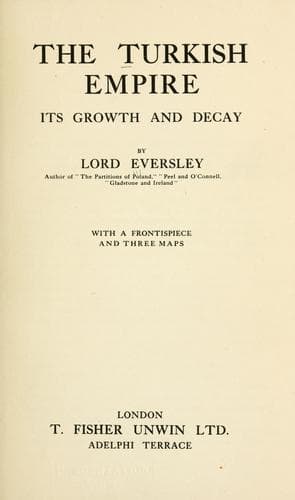
The Turkish Empire, Its Growth and DecayEversley, G. Shaw-Lefevre (George Shaw-Lefevre), Baron
History
The Turkish Empire, Its Growth and Decay
Eversley, G. Shaw-Lefevre (George Shaw-Lefevre), Baron
Turkey -- History
There may be added to these causes of ultimate decadence pointed
out by the Turkish historian another which must occur to those who
closely study the reign of Solyman—namely the growing influence in
State affairs of the Sultan’s harem. The fall and death of Ibrahim,
the murder of Prince Mustapha, and the rebellion and consequent death
of Prince Bayezid were mainly due to intrigues of the harem. Great
as Solyman was, he fell under the evil influence of his favourite
Sultana, the Russian Ghowrem, better known in history as Roxelana.
Ghowrem was not only a most seductive concubine; she was a very clever
and witty woman, with a great gift of conversation. She retained her
influence over Solyman when age had reduced her personal charms. By the
entreaties of the Sultan’s mother, who perceived the malign influence
of this woman over her son, she was for a time got rid of from the
Seraglio. But Solyman could not forget her, and insisted on her recall.
Ghowrem celebrated her triumph by getting the consent of the Sultan
to many executions. Thenceforth till her death her influence was
unbounded. “I live with the Sultan,” she said, “and make him do what I
wish.” Appointments to the highest offices were made at her instance
and abuses of all kinds arose. But worst of all was the precedent that
was set for the interference of the harem in matters of State.
With Solyman’s successors the influence of the harem was continually a
growing one, and was generally, though not always, as will be seen, a
danger to the State. It became increasingly necessary for a minister
who hoped to retain his post to secure personal support in the Sultan’s
harem. The harem itself became the centre of intrigue and corruption,
with fatal effect on the interests of the State. But worst of all
dangers to the Empire was the possibility—nay, the probability—that
the succession of the great man at the helm of State able to restrain
the lawlessness of the Janissaries, the fanaticism of the mullahs, and
the corruption of pashas might not be maintained. Solyman never did a
worse deed for the future of the Empire than when he put to death his
eldest son, who had proved himself to be in every way fit to succeed
him as Sultan, and when later, at the instance of Ghowrem, he secured
the succession of his son Selim. He knew that Selim was a worthless and
dissolute drunkard. He is said to have remonstrated with his son and
endeavoured to induce him to reform his conduct. It will be seen that
it was in vain. The succession of Selim was a nemesis for the murder of
Mustapha. He was the first of a long line of degenerates, who ruined
the great work of Solyman and his predecessors.
Public-domain text, read in full here on John Shaqi.
Reviews
Reviews
No reviews yet
Be the first to share your thoughts on this work.
Elsewhere in the archive
Join the Discussion
Join the discussion
Sign in to leave a comment or review.
Sign InorCreate an account