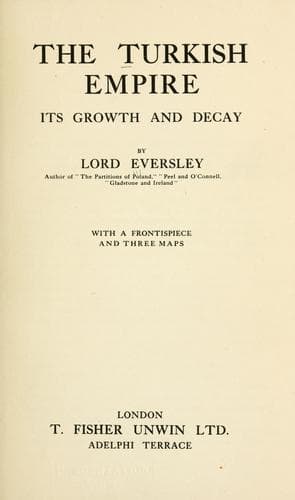
The Turkish Empire, Its Growth and DecayEversley, G. Shaw-Lefevre (George Shaw-Lefevre), Baron
History
The Turkish Empire, Its Growth and Decay
Eversley, G. Shaw-Lefevre (George Shaw-Lefevre), Baron
Turkey -- History
Murad, under the influence of these attractions, devoted himself wholly
to voluptuous life in his harem. He became the father of one hundred
and three children, of whom forty-seven survived him. The Sultana
Baffo, the mother of his eldest son, though she had lost her charm for
him as a mistress, continued to influence him in public affairs by her
wit and cleverness, sharing it, however, with the other ladies referred
to. After the death of the Sultana Validé, the Sultana Baffo succeeded
in regaining much of her earlier and exclusive influence. She retained
the same authority over her son Mahomet III, who succeeded his father
in 1595. It resulted, therefore, that this lady, for twenty-eight
years, exercised the greatest power in the State. Mahomet was as much
a nullity in public affairs as his father. He signalized his accession
to the throne by putting to death his nineteen brothers. He thought
apparently that this holocaust shed some lustre on these unfortunate
princes, for he accorded to them a State funeral. They were followed
to their graves by all the high dignitaries of the State, and were
buried beside their father. Six favourite slaves of the eldest of these
princes, who might be expected to give birth to future claimants to the
throne, were sewn up in sacks and were flung into the Bosphorus.
Mahomet was the last Sultan who was allowed before his accession to
have some experience in public affairs as governor of a province.
Thenceforward it was the practice for reigning Sultans to immure their
heirs in a building in the Seraglio, at Constantinople, known as the
Cage, where they were allowed to have no intercourse with the outer
world, and could have no experience, or even knowledge, of public
affairs, and which they only left either to reign as Sultans or to be
put to death. It has been suggested by some writers that this treatment
of the heirs to the Ottoman throne was the main cause of the lamentable
degeneracy of the Othman dynasty. It must undoubtedly have contributed
to this, but it should be noticed that the three Sultans, Selim II,
Murad III, and Mahomet III, who had not been subjected to this debasing
treatment, and had been governors of provinces before their accession,
were quite as worthless and incompetent as any of their successors.
Public-domain text, read in full here on John Shaqi.
Reviews
Reviews
No reviews yet
Be the first to share your thoughts on this work.
Elsewhere in the archive
Join the Discussion
Join the discussion
Sign in to leave a comment or review.
Sign InorCreate an account