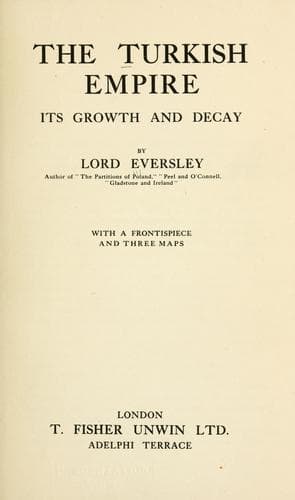
The Turkish Empire, Its Growth and DecayEversley, G. Shaw-Lefevre (George Shaw-Lefevre), Baron
History
The Turkish Empire, Its Growth and Decay
Eversley, G. Shaw-Lefevre (George Shaw-Lefevre), Baron
Turkey -- History
Mahomet, after eight years of a vacuous reign, was succeeded by his son
Achmet, who reigned for fourteen years. He was as incompetent to rule
as his two predecessors. He fell under the influence of other ladies
of his harem. The Sultana Baffo was ignored and lost her power. On the
death of Achmet, in 1617, he was succeeded not by his eldest son but
by his brother Mustapha, a lunatic. Achmet had spared his brother’s
life on account of his lunacy. Mustapha, therefore, by virtue of the
law of succession, succeeded, but he was deposed after a few months,
and was followed on the throne by Othman II, the son of Achmet, who
showed some greater capacity. In his short reign, however, of four
years he incurred the disfavour of the Janissaries, who insisted on his
deposition and death. The lunatic Mustapha was then reinstated on the
throne, and was again deposed, after a few months. He was succeeded by
Murad IV, a lad under twelve years. Till he came to years of discretion
his mother, the Sultana Validé, who was a clever woman, virtually
ruled. It will be shown later that Murad was of very different type
to his six predecessors. On coming of age he emancipated himself from
the influence of the harem, and was the last of his dynasty who was a
warrior and who personally led his army in the field. His rule lasted
for only eight years. On his death, in 1640, he was succeeded by his
brother Ibrahim II, a worthless voluptuary, during whose reign of
another eight years the harem recovered its influence. He was followed
by Mahomet IV, and for eight more years the rule of the harem was
maintained. From this brief narrative it will appear that from the
death of Sokolli in 1578 till 1656, a period of seventy-eight years,
during which seven Sultans occupied the throne, the supreme power in
the State was exercised by women of the harem, with the exception of
the eight years of the reign of Sultan Murad IV. For twenty-eight of
these years the Sultana Baffo, and later other ladies less known to
fame, were virtually the rulers of the Empire. Grand Viziers were made
and unmade at the will of these ladies, with occasional intervention
of the Janissaries. They seldom held the office for more than a year.
The Sultana Baffo was a grasping and avaricious woman. Under her evil
influence, and later that of other ladies of the harem, the system
of the sale of offices was greatly extended and became universal
throughout the Empire for all appointments, high and low.
Public-domain text, read in full here on John Shaqi.
Reviews
Reviews
No reviews yet
Be the first to share your thoughts on this work.
Elsewhere in the archive
Join the Discussion
Join the discussion
Sign in to leave a comment or review.
Sign InorCreate an account