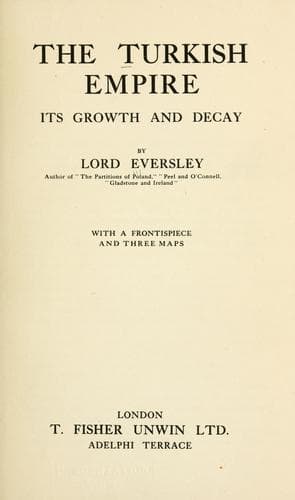
The Turkish Empire, Its Growth and DecayEversley, G. Shaw-Lefevre (George Shaw-Lefevre), Baron
History
The Turkish Empire, Its Growth and Decay
Eversley, G. Shaw-Lefevre (George Shaw-Lefevre), Baron
Turkey -- History
There was the greatest consternation at Constantinople at the loss of
so many strongholds and the defeat of the Turkish armies. There was
a general demand that the Sultan himself, the incompetent Mahomet,
should endeavour to restore confidence to the Turkish soldiers, by
putting himself at the head of them, as his predecessors had done in
past times. He was urged to unfurl the standard of the Prophet, and to
appeal to the religious fervour and fanaticism of the army. Mahomet
was most unwilling to adopt this course. He preferred to remain in
the Seraglio at Constantinople. The Sultana Baffo, fearing that her
influence might be lost if her son was out of her sight, backed his
refusal to march. On the other hand, his preceptor, the historian
Seadeddin, who had great influence over him, made every effort in the
opposite direction. At last the Janissaries refused to go to the front
unless their Padishah led them, and Mahomet, much against his will, was
compelled to put himself at the head of his army. The sacred standard
of the Prophet and his mantle, a most prized relic, were brought out
for the occasion. With much pomp the Ottomans marched northwards to
meet the invaders. The Austrians and Hungarians fell back at the
approach of this great army of Turks. They abandoned all the fortresses
they had captured in Bulgaria. They recrossed the Danube. The two
armies at last came into conflict on the plain of Cerestes, in Hungary,
on the 24th of October, 1596, where a memorable battle took place,
extending over three days.
It does not appear that Mahomet took any part in the direction of his
army. The Grand Vizier was virtually in command. The second in command
was Cicala, an Italian by birth who had embraced Islam, a most brave
and resolute soldier, greatly favoured by the ladies of the harem. The
Sultan, however, was present in the field, surrounded by his bodyguard.
The sacred banner of the Prophet was unfurled and roused, it was said,
the fervour of the Turkish soldiers. On the first day the Turks met
with a reverse, and a division of their army was defeated. A council
of war was held, at which Mahomet expressed his wish to retreat and to
avoid further battle. Seadeddin stoutly opposed this. “It has never
been seen or heard of,” he said, “that a Padishah of the Ottomans
turned his back upon the enemy without the direst necessity.” Mahomet
then suggested that he himself should withdraw from the battle, and
that the Grand Vizier, Hassan Pasha, should take command of the army.
“This is no affair for pashas,” said Seadeddin, “the presence of the
Padishah is indispensably necessary.” It was decided to continue the
battle in the presence of the Sultan.
Public-domain text, read in full here on John Shaqi.
Reviews
Reviews
No reviews yet
Be the first to share your thoughts on this work.
Elsewhere in the archive
Join the Discussion
Join the discussion
Sign in to leave a comment or review.
Sign InorCreate an account