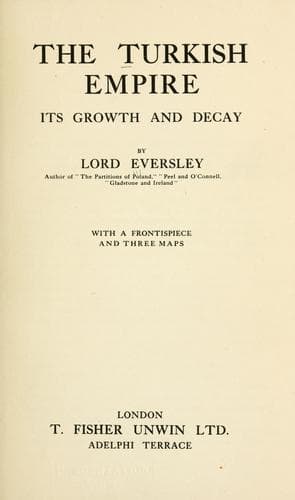
The Turkish Empire, Its Growth and DecayEversley, G. Shaw-Lefevre (George Shaw-Lefevre), Baron
History
The Turkish Empire, Its Growth and Decay
Eversley, G. Shaw-Lefevre (George Shaw-Lefevre), Baron
Turkey -- History
The second day was no better for the Ottomans than the first. On the
third day, October 26th, the two main armies came into closer quarters.
The Hungarians, under Count Pfalfi, attacked the Ottoman artillery in
flank and captured all the guns. The battle seemed to be irretrievably
lost. The Sultan, seated on a tall camel, surrounded by his bodyguard,
watched the rout of his army. He wished to fly while there was time. He
was dissuaded again by Seadeddin, who quoted a verse from the Koran:
“It is patience which wins victory, and joy succeeds to sorrow.” The
Sultan, wrapping the Prophet’s mantle round him, consented to remain on
the field.
The Austrians now charged the Ottoman camp. The Imperial soldiers,
breaking their ranks, devoted themselves to plunder. At this point
Cicala, at the head of a large body of irregular cavalry, which had
taken no part so far in the battle, charged with irresistible force the
scattered host of the Christians. They carried everything before them.
The Austrians, in their turn, were driven from the field. Maximilian
and Sigismund were compelled to fly for their lives.
The Ottomans, as a result of this gallant charge, regained all that
they had lost. Thirty thousand Austrians and Hungarians perished.
Ninety-five of their guns were captured. The camp and the treasure
of the Archduke were taken. Never was a more complete and unexpected
victory. No thanks, however, were due to the Sultan. There can be no
doubt that if he had acted on his own impulse and had fled, the battle
would have been lost. He was a timid spectator of the conflict, and of
much the same use as the sacred standard and the cloak of the Prophet.
The victory was undoubtedly due to the courage of Cicala and the
splendid charge of his cavalry, and to the determination of Seadeddin
in compelling his master the Sultan, against his will, to remain on the
field of battle.
No more important battle had taken place beyond the Danube since that
of Mohacz in the time of Mahomet II. If the victory had resulted to
the Christians, the whole of the Ottoman possessions north of the
Danube would have been lost. The Christian army, under Maximilian,
would again have crossed that river and have advanced into Bulgaria and
Macedonia, and the dismemberment of the Ottoman Empire might have been
precipitated by two or three centuries.
The craven Sultan returned to Constantinople immediately after the
battle. He received there a great ovation for the victory due to
Cicala. Never again did he lead an army on the field. He devoted
himself thenceforth to a voluptuous life in his harem. The government
of the Empire remained in the hands of the Sultana Validé.
Public-domain text, read in full here on John Shaqi.
Reviews
Reviews
No reviews yet
Be the first to share your thoughts on this work.
Elsewhere in the archive
Join the Discussion
Join the discussion
Sign in to leave a comment or review.
Sign InorCreate an account